Meaning of the Name Osiris
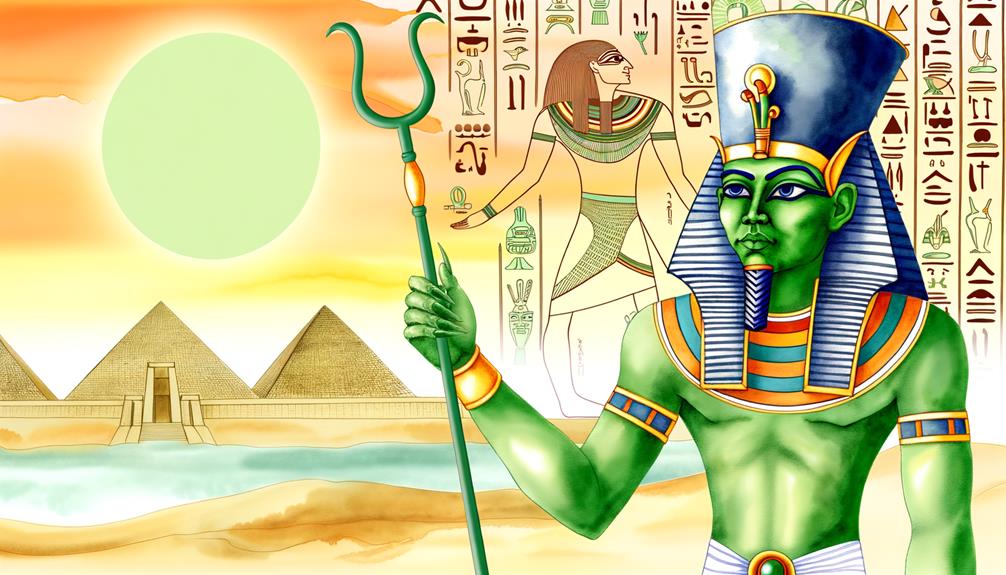
The name Osiris originates from the ancient Egyptian terms "Asar" or "Usir," which mean "powerful" or "mighty." It encompasses both linguistic and symbolic connotations linked to power, authority, and rebirth. Osiris is a central figure in Egyptian mythology, revered as the god of the afterlife, resurrection, and fertility.
His mythology includes themes of death, resurrection, and eternal life. Represented with green skin, an Atef crown, and the crook and flail, Osiris symbolizes kingship and stability.
His influence extends to various cultures and continues to captivate modern imagination. Continue to explore and uncover the enduring legacy of this ancient deity.
Key Takeaways
- The name Osiris is derived from the ancient Egyptian language.
- It is believed to be a Hellenized form of ‘Asar' or ‘Usir.'
- Linguistic analysis suggests it means 'powerful' or 'mighty.'
- Osiris is associated with the concepts of 'eye' or 'throne.'
- The name reflects a syncretic blending of ancient cultures.
Etymology of Osiris
Derived from the ancient Egyptian language, the name Osiris is believed to be a Hellenized form of the original Egyptian name 'Asar' or 'Usir.'
The etymology of Osiris has intrigued scholars, leading to various interpretations. Linguistic analysis suggests that 'Asar' may be derived from the Egyptian words meaning 'powerful' or 'mighty,' reflecting Osiris's significant role in ancient Egyptian culture.
Another theory posits that the name could be associated with the concept of an 'eye' or 'throne,' aligning with his divine status. The shift from 'Asar' to 'Osiris' illustrates the influence of Greek interpretation on Egyptian mythology, demonstrating a syncretic blending of cultures.
This complex etymological evolution underscores the multifaceted nature of Osiris's identity.
Osiris in Egyptian Mythology
Understanding the etymology of Osiris provides a foundational context for examining his pivotal role within Egyptian mythology, where he is revered as the god of the afterlife, resurrection, and fertility. His significance is highlighted in several key aspects of mythological narratives:
- The Osiris Myth: Central to the myth is Osiris' murder by his brother Seth, his resurrection by Isis, and his reign as the ruler of the underworld.
- The Judgment of the Dead: Osiris presides over the weighing of the heart ceremony, determining the fate of souls in the afterlife.
- Agricultural Symbolism: As a fertility god, Osiris is linked to the Nile's annual flooding and crop growth.
- Royal Kingship: Pharaohs often identified with Osiris, embodying his attributes to legitimize their rule.
This overview underscores Osiris' complex and influential position within Egyptian cosmology.
Symbolism and Attributes
In Egyptian mythology, the symbols and attributes associated with Osiris serve to elucidate his multifaceted role as a deity of the afterlife, resurrection, and fertility.
Iconographically, Osiris is often depicted with green skin, symbolizing rebirth and regeneration. His traditional headdress, the Atef crown, signifies his authority and connection to the divine. Additionally, Osiris is frequently portrayed holding a crook and flail, emblems of kingship and agricultural fertility, respectively.
The Djed pillar, another potent symbol, represents stability and eternal life, further emphasizing Osiris's role in sustaining the cosmos.
Collectively, these attributes not only highlight his integral position within the Egyptian pantheon but also reflect the cultural and religious values centered around life, death, and renewal.
Historical Evolution
How has the perception of Osiris changed throughout different periods of Egyptian history, reflecting broader cultural and religious shifts?
The evolution of Osiris' role is marked by significant shifts:
- Predynastic Period: Initially a regional fertility deity, Osiris' influence was primarily local.
- Old Kingdom: He became the central figure in royal mortuary cults, symbolizing resurrection and eternal life for pharaohs.
- Middle Kingdom: Osiris' accessibility expanded, offering common people the promise of an afterlife, demonstrating a democratization of religious beliefs.
- New Kingdom and Later Periods: His mythology became more intricate, integrating with other deities, thereby reflecting a more syncretic and complex religious landscape.
These phases illustrate Osiris' transformation from a local deity to a universal symbol of death and rebirth, mirroring Egypt's evolving societal structures.
Osiris in Modern Culture
Despite the millennia that separate ancient Egypt from the present day, the figure of Osiris continues to captivate modern culture through various mediums, including literature, art, and popular media. Scholars have noted his representation in contemporary novels, where Osiris symbolizes themes of resurrection and justice.
Artists frequently draw upon his iconography, integrating Egyptian motifs to explore concepts of life and death. In popular media, Osiris appears in films and video games, often embodying wisdom and the afterlife. This enduring fascination underscores the cultural resonance of Osiris, whose mythological narrative transcends temporal and geographic boundaries.
His portrayal in modern contexts not only reflects historical continuity but also highlights the adaptability of ancient symbols in addressing contemporary issues.
Interpretations and Analysis
The mythological significance of the name Osiris presents a multifaceted narrative steeped in themes of resurrection and kingship, which has been subject to extensive scholarly analysis.
Concurrently, the modern usage of the name Osiris reflects both an homage to ancient traditions and an evolving cultural symbolism.
This duality underscores the enduring impact and adaptability of the name across various contexts and epochs.
Mythological Significance Explored
Examining the mythological significance of the name Osiris reveals a profound connection to themes of resurrection, kingship, and the cyclical nature of life and death in ancient Egyptian culture. Osiris, often depicted as the god of the afterlife, symbolizes the eternal cycle of death and rebirth, essential to Egyptian cosmology. Scholarly interpretations highlight:
- Resurrection and Afterlife: Osiris' death and subsequent resurrection underscore the hope for eternal life.
- Kingship: As a divine king, Osiris represents the ideal ruler, embodying justice and order.
- Agricultural Symbolism: His myth ties to the annual flooding of the Nile, symbolizing fertility and renewal.
- Moral Order: Osiris' role in the judgment of souls established moral guidelines for ancient Egyptians.
These aspects illustrate Osiris' multifaceted role in mythological narratives.
Modern Name Usage
Modern interpretations of the name Osiris often reflect a confluence of ancient mythological significance and contemporary cultural trends, revealing insights into how historical narratives continue to shape present-day identity and symbolism.
In contemporary society, Osiris is frequently invoked in literature, popular media, and even in branding, embodying themes of resurrection, justice, and transformation. This usage underscores a collective fascination with the ancient deity's attributes, particularly his role as the god of the afterlife and rebirth.
Moreover, the name Osiris is sometimes adopted in personal naming conventions, symbolizing hope and renewal. Scholarly analysis suggests that this modern appropriation not only preserves cultural heritage but also adapts it to resonate with evolving societal values and existential quests.
Comparative Mythology
In the domain of comparative mythology, Osiris holds a pivotal role within Egyptian mythology as the god of the afterlife, resurrection, and agriculture.
Examining Osiris alongside other deities from different mythological traditions, such as the Greek god Dionysus or the Mesopotamian god Tammuz, reveals intriguing parallels and distinctions in themes of death and rebirth.
This analysis facilitates a deeper understanding of how ancient cultures conceptualized divinity and the afterlife.
Osiris in Egyptian Mythology
As the central figure in Egyptian mythology, Osiris serves as a poignant symbol of death, resurrection, and the cyclical nature of life, offering rich comparative insights with other mythological traditions. His narrative includes being murdered by his brother Set, his subsequent resurrection by his wife Isis, and his role as the ruler of the afterlife. These elements resonate across various cultures, providing a fertile ground for comparative mythology.
Key points of comparison include:
- Dionysus (Greek Mythology) – Shares themes of death and rebirth.
- Baldur (Norse Mythology) – His death and eventual resurrection symbolize renewal.
- Tammuz (Mesopotamian Mythology) – Represents the cyclical nature of life and death in agricultural societies.
- Quetzalcoatl (Mesoamerican Mythology) – Embodies life, death, and rebirth cycles.
These parallels underscore Osiris's profound influence beyond Egyptian borders.
Osiris and Other Deities
Building on the pervasive themes of death and resurrection in Osiris's narrative, a comparative analysis with deities from other mythological traditions illuminates shared symbolic frameworks and cultural archetypes.
The Greek god Dionysus, for instance, parallels Osiris through his own cycles of death and rebirth, underscoring the universality of regeneration motifs.
Similarly, the Mesopotamian deity Tammuz and the Hindu god Shiva embody themes of life, death, and renewal, reflecting an intrinsic human preoccupation with mortality and afterlife.
These comparisons suggest a cross-cultural resonance in which deities like Osiris serve as metaphors for the cyclical nature of existence.
Such archetypal patterns reveal a collective mythological consciousness that transcends geographical and temporal boundaries, providing profound insights into ancient human belief systems.
Conclusion
In sum, the name Osiris, steeped in rich etymology and profound mythological significance, serves as a cornerstone of ancient Egyptian culture. The god Osiris embodies themes of resurrection, fertility, and governance, evolving through history while maintaining enduring relevance in modern culture.
'Knowledge is power'; understanding Osiris's multifaceted symbolism and comparative mythology offers invaluable insights into ancient and contemporary worldviews. This exploration underscores the lasting impact and intricate complexity of Osiris within the broader tapestry of human belief systems.