Meaning of the Name Romulus
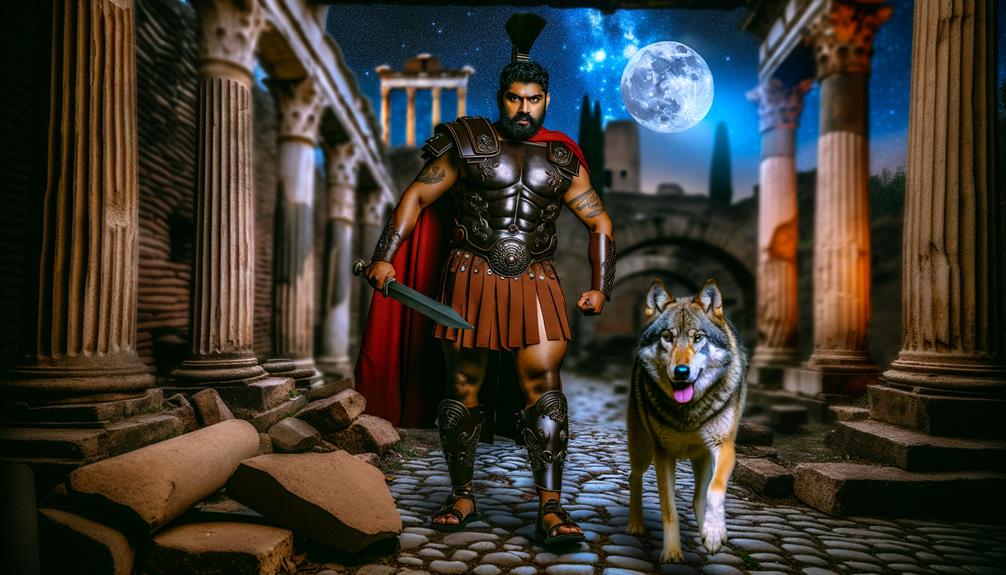
The name Romulus is rooted in ancient Roman mythology, tied to the legendary founder and first king of Rome. Derived from the Latin term ‘Romulus,’ it underscores the cultural and historical significance of the city, Roma. Romulus and his twin brother Remus, renowned for being raised by a she-wolf, symbolize Rome’s foundational values of strength, resilience, and leadership. The name originates from ‘Romanus,’ meaning ‘a Roman,’ reflecting the city’s legacy.
The name Romulus is rooted in ancient Roman mythology, tied to the legendary founder and first king of Rome. Derived from the Latin term 'Romulus,' it underscores the cultural and historical significance of the city, Roma.
Romulus and his twin brother Remus, renowned for being raised by a she-wolf, symbolize Rome's foundational values of strength, resilience, and leadership. The name originates from 'Romanus,' meaning 'a Roman,' reflecting the city's legacy.
Romulus is immortalized in literary works such as Livy's 'Ab Urbe Condita' and Ovid's 'Fasti.' Discover more about his profound impact on Roman identity and governance.
Key Takeaways
- Romulus is the legendary founder and first king of Rome.
- The name derives from the Latin term 'Romulus,' linked to 'Romanus' meaning 'a Roman.'
- Raised by a she-wolf, Romulus symbolizes Rome's values of strength, resilience, and leadership.
- Romulus' name is central to Roman mythology and the city's historical identity.
- The name Romulus symbolizes themes of creation, leadership, and cultural legacy.
Origins of Romulus
The name Romulus finds its origins in ancient Roman mythology, where it is intrinsically linked to the legendary founder and first king of Rome. According to myth, Romulus, alongside his twin brother Remus, was central to the establishment of the city in 753 BCE.
Raised by a she-wolf after being abandoned, Romulus's narrative establishes him as a seminal figure in Roman lore. Historically, this myth not only explains the city's founding but also embodies Rome's values of strength, resilience, and leadership.
The story of Romulus has been perpetuated through Roman literature and art, shaping cultural identity. His name, hence, signifies more than just an individual; it represents the genesis of Rome's imperial grandeur and enduring legacy.
Etymology of the Name
The name Romulus is rooted in ancient Roman tradition, carrying significant mythological weight as the purported founder of Rome.
Linguistically, it is believed to derive from the Latin term 'Romulus,' which itself is linked to the city's name, Roma.
This etymological foundation not only reflects the historical importance of the figure but also underscores the interplay between language and cultural identity in early Roman civilization.
What Should You Know About Ancient Roman Origins?
Rooted in the rich tapestry of ancient Roman history, the name Romulus is derived from the Latin word 'Romulus,' signifying its profound connection to the legendary founder of Rome.
The etymology of the name is deeply embedded in the Latin language, wherein 'Romulus' is thought to originate from the root 'Romanus,' meaning 'a Roman.' This linguistic connection underscores the significance of the name as a symbol of Roman identity and heritage.
Ancient texts and inscriptions frequently reference Romulus, cementing his place in the annals of Roman history. The name, henceforth, not only denotes an individual but also encapsulates the essence of Rome's foundational mythos, reflecting the city's cultural and historical legacy.
What Should You Know About Mythological Significance?
In the world of Roman mythology, the name Romulus evokes profound significance, interweaving etymological roots and legendary narratives to embody the essence of Rome's storied inception.
Romulus, alongside his twin brother Remus, is central to the foundation myth of Rome, which chronicles their miraculous survival and subsequent establishment of the city.
The mythological significance of Romulus lies in his role as the city's first king, a figure of martial prowess and leadership. This narrative not only illustrates the valor and fortitude attributed to Rome's origins but also underscores the name Romulus as a symbol of strength, unity, and sovereignty.
The legendary tales surrounding Romulus have indelibly shaped the cultural and historical identity of ancient Rome.
What Should You Know About Linguistic Roots?
Tracing back to ancient Latin, the name Romulus is believed to derive from 'Romulus' itself, which signifies 'little Rome' or 'citizen of Rome,' reflecting the deep connection to the city's identity. This etymology underscores the intrinsic link between the name and the foundation of Rome. The linguistic roots are pivotal in understanding the cultural and historical significance of Romulus. The table below delineates the linguistic components and meanings:
| Latin Term | Meaning |
|---|---|
| Romulus | Little Rome |
| Roma | Rome |
| -ulus | Diminutive Suffix |
| -anus | Citizen of |
This linguistic analysis provides insight into the ancient Roman perception of identity and belonging.
Romulus in Mythology
In Roman mythology, Romulus is celebrated as the founder of Rome and is central to the city's legendary origins. Alongside his twin brother Remus, Romulus is said to have been raised by a she-wolf, an enduring symbol that underscores the myth's significance.
This foundational narrative not only establishes Romulus as a pivotal figure in Roman history but also reflects the linguistic and cultural roots of his name.
What Should You Know About Founding of Rome?
Romulus, a central figure in Roman mythology, is traditionally credited with founding the city of Rome in 753 BCE. This foundational myth forms an essential element of Roman identity and historical narrative.
According to ancient sources, Romulus established the initial settlement on the Palatine Hill, where he laid out the city's boundaries and initiated its first civic and religious institutions. The name 'Rome' itself is etymologically linked to Romulus, signifying his integral role in the city's inception.
His act of founding Rome was not merely a physical establishment but also a cultural and political genesis, embedding his legacy within the core of Roman civilization. This mythological account underscores the enduring influence of Romulus in Rome's historical and cultural framework.
How Does Romulus and Remus Impact Your Choice?
Central to the mythological narrative of Rome's origins is the tale of the twin brothers, Romulus and Remus, whose story intertwines themes of kinship, rivalry, and divine destiny. According to legend, they were the sons of Rhea Silvia and Mars, the god of war. Abandoned and left to perish, they were miraculously saved and suckled by a she-wolf.
Key elements of their myth include:
- Fraternal Conflict: The brothers eventually quarreled over the founding of Rome, leading Romulus to kill Remus.
- Divine Favor: Romulus was perceived as favored by the gods, legitimizing his rule.
- Foundation Ceremony: Romulus established ritual practices and the nascent city's boundaries, marking the genesis of Rome.
This myth encapsulates the intertwining of divine influence and mortal strife in Rome's foundation.
Historical Significance
Renowned for his foundational role in Roman mythology, Romulus's historical significance extends beyond legend, reflecting the sociopolitical structures and cultural values of early Rome. As the purported founder of Rome, Romulus symbolizes the nascent city's governance, military ethos, and societal norms. His narrative encapsulates the shift from tribal communities to a centralized state, mirroring Rome's evolution into a republic and later an empire.
```markdown
| Aspect | Significance |
|---|---|
| Governance | Establishment of Roman Senate |
| Military Ethos | Romulus's role in forming Roman legions |
| Societal Norms | Symbolizes Roman virtues and citizenship |
```
Through Romulus, early Roman history intertwines with myth, creating a foundational mythos that underscores Rome's perceived destiny and cultural identity. His name, thus, carries profound historical resonance.
Cultural Impact
The enduring legacy of Romulus not only shaped the political and military framework of Rome but also permeated its cultural and societal fabric, influencing art, literature, and civic traditions for centuries. His mythological origins and heroic deeds have been immortalized through various cultural manifestations, leaving an indelible mark on Roman identity.
Significant cultural impacts include:
- Artistic Representation: Romulus frequently appears in Roman sculpture and frescoes, symbolizing foundational myths.
- Civic Rituals: The Lupercalia festival, celebrating Romulus and Remus, highlighted communal unity and purification rites.
- Architectural Influence: Monuments such as the Forum Romanum reflect Romulus' lasting architectural legacy, embodying Rome's foundational myths.
These elements underscore Romulus' pervasive influence on Rome's cultural and societal evolution.
Romulus in Literature
Romulus' mythological narrative has been extensively explored in classical literature, providing a rich source of inspiration for ancient authors and poets.
Livy's 'Ab Urbe Condita' meticulously recounts Romulus' role in Rome's foundation, blending historical and mythological elements. Similarly, Ovid's 'Fasti' poetically immortalizes Romulus, emphasizing his divine heritage and martial prowess.
The linguistic significance of Romulus, derived from 'Rōma,' underscores his centrality in Rome's etymological and cultural genesis. In addition, Plutarch's 'Life of Romulus' offers a biographical approach, highlighting both Romulus' legendary and human traits.
Through these varied literary works, Romulus is portrayed not merely as a founder but as a symbol of Rome's enduring identity, embodying themes of leadership, divinity, and civic virtue.
Modern Usage
While classical literature solidified Romulus' mythic stature, modern usage of his name often reflects its historical and cultural resonance in contemporary society. The name Romulus is employed in various contexts, illustrating its lasting impact.
- Literature and Media:
Contemporary authors and filmmakers invoke Romulus to evoke themes of leadership and foundational myths.
- Scientific Nomenclature:
Astronomical bodies and scientific projects are occasionally named Romulus, symbolizing exploration and discovery.
- Commercial Branding:
Companies sometimes adopt the name Romulus to suggest strength, innovation, and pioneering spirit.
These modern usages underscore the enduring significance of Romulus, seamlessly bridging ancient lore with present-day applications.
The name continues to invoke a sense of origin, authority, and enduring legacy, reflecting its deep-rooted historical and cultural dimensions.
Symbolism and Legacy
In both historical and mythological contexts, Romulus symbolizes the archetype of the foundational hero, embodying themes of creation, leadership, and cultural identity. As the legendary founder of Rome, his narrative reflects the essence of Roman virtue and governance. Romulus' symbolism extends beyond his myth, influencing Roman culture, law, and even modern interpretations of leadership.
| Symbolism | Legacy |
|---|---|
| Foundational Hero | Establishment of Rome |
| Leadership | Roman Law and Governance |
| Cultural Identity | Influence on Western Civilization |
Romulus' tale is not merely a mythological account but a profound source of Roman ideals. His legacy is etched in the annals of history, reinforcing the cultural and societal frameworks that define Rome's enduring impact on Western civilization.
Conclusion
The name Romulus encapsulates a rich tapestry of historical and mythological significance. Rooted in ancient Roman culture, it symbolizes foundational leadership, akin to how the legendary Romulus is credited with the creation of Rome itself.
Much like the enduring city, the name Romulus endures through time, resonating with themes of origin, power, and legacy. This linguistic and cultural artifact continues to evoke a sense of primordial strength and perpetual influence across various domains.