Toledo Name Origin and Meaning
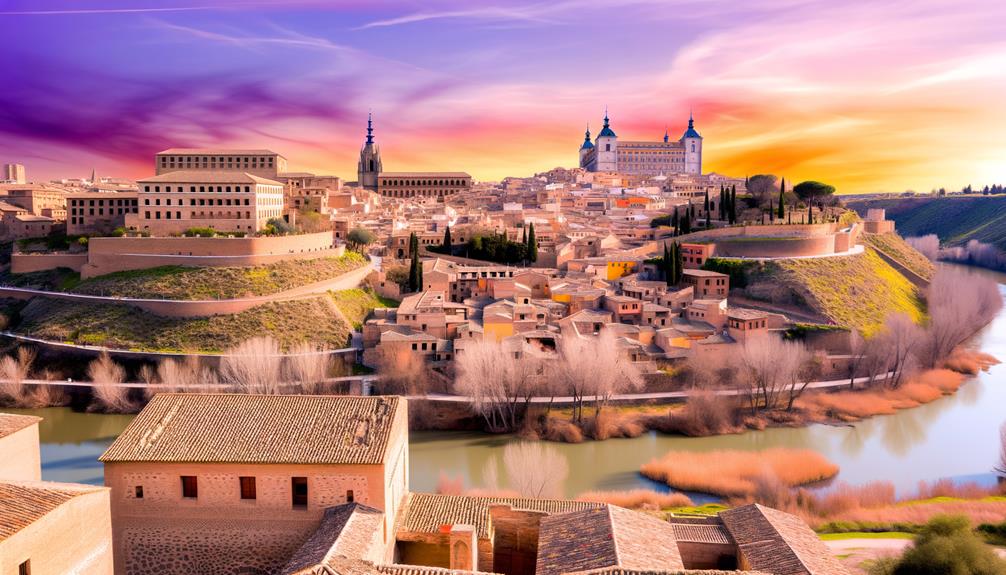
The name Toledo traces its origin to the Latin term 'Toletum,' coined during Roman rule to designate a significant administrative center overlooking the Tagus River. This term likely adapted from pre-existing Celtic or Iberian names, exemplifying Roman practices of integrating local nomenclature.
Throughout medieval times, the name evolved under Visigothic and Moorish influences, ultimately transforming into 'Toledo' in Castilian Spanish. The name reflects a rich tapestry of cultural and linguistic heritage, evident in the city's historical and architectural significance.
Toledo's enduring legacy as a cultural hub invites deeper exploration into its multifaceted history.
Key Takeaways
- Toledo originates from the Latin term 'Toletum,' established during Roman rule.
- The name 'Toletum' reflects the Roman practice of Latinizing pre-existing Celtic or Iberian names.
- Toledo's name evolved through Visigothic and Moorish influences, becoming 'Toledo' in medieval Castilian.
- The city of Toledo, Ohio, adopted its name in 1837, inspired by the Spanish city's heritage.
- Toledo is recognized as a UNESCO World Heritage Site, showcasing its historical and cultural significance.
Ancient Roman Roots
The origins of the name Toledo can be traced back to its ancient Roman roots, specifically to the Latin term 'Toletum,' which was used to describe the area during the Roman occupation of the Iberian Peninsula.
This nomenclature was likely derived from the pre-existing Celtic or Iberian names, adapted by the Romans to fit their linguistic and cultural frameworks. The strategic significance of Toledo, positioned on a hill overlooking the Tagus River, made it an essential military and administrative center.
This Roman influence not only shaped the city's name but also laid the groundwork for its historical prominence. Subsequent eras built upon this Roman foundation, preserving 'Toletum' as a pivotal reference point in the region's evolving identity.
The Latin 'Toletum'
Etymological analysis of 'Toletum' reveals its roots in the Latin language, reflecting the Roman practice of adapting local names to their linguistic system. The name 'Toletum' itself is derived from a pre-Roman term, likely of Celtiberian origin, which the Romans Latinized upon their conquest and settlement.
This adaptation was part of a broader strategy to integrate conquered territories into the Roman Empire, both administratively and culturally. The suffix '-etum' in Latin often denotes a place or a collection of something, implying that 'Toletum' might have referred to a specific geographic or cultural feature significant to the Romans.
Understanding this Latinization process provides insight into how ancient Roman nomenclature influenced the evolution of place names in their empire.
Medieval Spanish Influence
During the medieval period, the name 'Toletum' evolved significantly under the influence of the various cultures that dominated the Iberian Peninsula, including the Visigoths and later the Moors. The Visigoths, who established their rule in Toledo in the 6th century, contributed to the city's prominence and, by extension, its nomenclature.
Subsequent Moorish conquest in the 8th century introduced Arabic linguistic elements, further shaping the name. Toledo became a center of learning, where Islamic, Christian, and Jewish cultures intermingled, fostering a unique syncretic identity. This multicultural environment influenced the phonetic and orthographic transformations of 'Toletum,' ultimately adapting into the medieval Castilian 'Toledo.'
Such evolution reflects the complex historical layers embedded within the city's name.
Toledo in Modern Spain
In modern Spain, Toledo continues to be a city of profound historical significance, with its well-preserved medieval architecture and cultural heritage attracting both scholars and tourists.
The city's commitment to preserving its historical assets is evident in numerous restoration projects and cultural initiatives.
Today, Toledo not only stands as a proof of its storied past but also serves as a vibrant hub for modern-day attractions, blending historical legacy with contemporary cultural experiences.
What Should You Know About Historical Significance Today?
Toledo's historical significance in modern Spain is underscored by its well-preserved medieval architecture and its designation as a UNESCO World Heritage Site. The city stands as a tribute to its layered history, housing structures from Roman, Visigothic, Moorish, and Christian periods.
Toledo's Alcázar fortress and the Cathedral of Saint Mary are exemplars of its rich architectural heritage. The city's labyrinthine streets and ancient synagogues reflect its multicultural past, where Jewish, Christian, and Muslim communities coexisted.
Today, Toledo serves as a focal point for historical tourism, offering insights into Spain's complex cultural tapestry. Its continued relevance is evident in the academic studies and cultural events centered around its storied past, making it an indispensable part of Spain's historical narrative.
What Should You Know About Cultural Heritage Preservation?
As a city that epitomizes the confluence of diverse historical epochs, Toledo's current efforts in cultural heritage preservation are pivotal in maintaining its architectural and cultural integrity for future generations.
The city employs a multifaceted approach, incorporating legislative frameworks, advanced restoration techniques, and community engagement. Strict regulations protect its historic buildings, while modern technologies such as 3D scanning and digital archiving guarantee accurate restorations.
Additionally, public awareness initiatives foster a collective sense of responsibility towards heritage conservation. Toledo's collaborative efforts with international organizations further enhance its preservation strategies, ensuring adherence to global standards.
This structured approach not only safeguards Toledo's rich history but also promotes sustainable tourism, balancing preservation with contemporary urban needs.
What Should You Know About Modern-day Attractions?
A myriad of modern-day attractions in Toledo seamlessly blend its historical richness with contemporary experiences, offering visitors a unique journey through time.
The city's well-preserved medieval architecture, epitomized by the Alcázar and Toledo Cathedral, provides a backdrop for modern cultural activities, including concerts and art exhibitions.
The Zocodover Square, once a bustling market, now serves as a vibrant hub of cafes and shops.
The Sephardic Museum and El Greco Museum present in-depth explorations of Toledo's multicultural past while engaging modern audiences.
Additionally, the city's innovative gastronomy scene, featuring Michelin-starred restaurants, highlights traditional Castilian flavors with contemporary twists.
Collectively, these attractions underscore Toledo's ability to honor its past while embracing the present.
Toledo, Ohio Connections
The connections between Toledo, Ohio, and its Spanish namesake are multifaceted. They encompass historical background links, economic growth ties, and cultural exchange influences.
Historically, Toledo, Ohio, adopted its name in 1837, reflecting a desire to evoke the rich heritage of the ancient Spanish city.
Economically and culturally, the relationship has been fostered through various initiatives that promote bilateral trade, cultural events, and educational exchanges. These efforts have enriched both communities.
What Should You Know About Historical Background Links?
Drawing from historical records, Toledo, Ohio's connections to its namesake in Spain are rooted in the city's establishment and development during the 19th century. The choice of the name 'Toledo' was influenced by the settlers' admiration for the Spanish city, known for its rich cultural heritage and historical significance.
Founded in 1833, Toledo, Ohio, was strategically located near the Maumee River, facilitating transportation and trade. This strategic positioning mirrored Toledo, Spain's historical importance as a cultural and economic hub. The name likely aimed to evoke the grandeur and historical depth associated with its European counterpart, thereby attracting settlers and investors.
These historical connections laid the groundwork for Toledo, Ohio's emergence as a significant American city.
What Should You Know About Economic Growth Ties?
Facilitating its economic growth, Toledo, Ohio leveraged its strategic location near the Maumee River to become a pivotal transportation and trade hub in the 19th and early 20th centuries. The city's proximity to the Great Lakes enhanced its accessibility, fostering robust shipping routes.
The advent of the Miami and Erie Canal further amplified commercial activity, linking Toledo to Cincinnati and the Ohio River. Additionally, the burgeoning railroad network solidified Toledo's role in regional commerce. Industrialization flourished, with the glass industry, automotive manufacturing, and oil refining sectors establishing significant operations.
These developments not only stimulated local employment but also attracted a wave of immigrants, thereby contributing to Toledo's demographic diversification and economic resilience.
What Should You Know About Cultural Exchange Influences?
Leveraging its diverse immigrant population, Toledo, Ohio has become a vibrant mosaic of cultural exchange, enriching the city's social fabric and fostering international connections. The city's history of welcoming various ethnic groups has led to a unique blend of traditions and practices.
- Ethnic Festivals: Events like the Toledo International Festival celebrate the city's multiculturalism, featuring cuisine, music, and dances from around the world.
- Cultural Institutions: Establishments such as the Toledo Museum of Art and the Toledo Symphony Orchestra offer programs inspired by global artistic traditions.
- Educational Programs: Local schools and universities provide language courses and cultural studies programs, promoting cross-cultural understanding and collaboration.
These elements collectively contribute to Toledo's dynamic cultural landscape, making it a microcosm of global diversity.
Cultural and Historical Significance
The cultural and historical significance of Toledo is deeply rooted in its rich tapestry of influences from various civilizations, including the Romans, Visigoths, Moors, and Christians. Each epoch has left an indelible mark on the city, transforming it into a melting pot of architectural styles, languages, and traditions.
Roman foundations laid the groundwork for urban infrastructure, while Visigothic rule brought early Christian influences. The Moorish period introduced Islamic art and science, fostering an environment of intellectual prosperity. The Christian Reconquista and subsequent coexistence led to Toledo being dubbed the 'City of Three Cultures.'
This amalgamation is evident in the city's synagogues, mosques, and churches, which coexist as a tribute to its diverse and layered history.
Conclusion
The name 'Toledo' encapsulates a rich tapestry of history, from its ancient Roman roots and the Latin 'Toletum' to its evolution under medieval Spanish influence and its contemporary significance in modern Spain and Toledo, Ohio.
Significantly, Toledo, Spain, has been continuously inhabited for over 2,000 years, underscoring its enduring cultural and historical significance.
This long-standing habitation highlights the city's pivotal role in various epochs, making it a focal point of historical and cultural inquiry.