Sinclair Name Meaning and Origin
The surname 'Sinclair' has its origins in Norman roots, deriving from the French town of Saint-Clair, possibly named after Saint Clair of Assisi or Saint Clair of Nantes. It was introduced to England by Norman settlers following the Norman Conquest of 1066, which notably influenced England's cultural and linguistic landscape.
The name further expanded into Scotland through historical migrations and alliances, establishing the Sinclair family as notable Scottish nobility. Over time, Sinclairs have contributed significantly to literature, architecture, and social reforms.
This name's journey from Norman beginnings to modern-day relevance offers a profound historical narrative.
Key Takeaways
- The Sinclair surname has Norman roots and originates from the French town of Saint-Clair.
- It likely derives its name from Saint Clair of Assisi or Saint Clair of Nantes.
- The name was introduced to England by Norman settlers following the Norman Conquest of 1066.
- The Sinclairs became a prominent noble family in Scotland through land grants and alliances.
- The surname has evolved in pronunciation and spelling due to linguistic changes over time.
Etymology of Sinclair
The etymology of the surname Sinclair can be traced back to its Norman roots, deriving from the French town of Saint-Clair. This locale, named for its clear or bright saint, likely refers to Saint Clair of Assisi or Saint Clair of Nantes.
The name Saint-Clair was brought to England by Norman settlers following the Norman Conquest of 1066. Over time, the pronunciation and spelling evolved, adapting to the English language and culture. The shift from 'Saint-Clair' to 'Sinclair' exemplifies the linguistic alterations influenced by regional dialects and phonetic simplifications.
Understanding this etymology provides insight into the historical migration patterns and cultural integrations that shaped the surname Sinclair, reflecting its enduring legacy and historical significance.
Norman Conquest Influence
The Norman Conquest of 1066 notably impacted the cultural landscape of England, leading to the integration of Norman customs and nomenclature, including the adoption of the Sinclair name.
This period saw the establishment of a Norman aristocracy that infused the existing Anglo-Saxon traditions with their own, creating a unique medieval Norman legacy that is still evident in many British surnames today.
The Sinclair name, tracing its origin to the Norman 'Saint-Clair,' exemplifies this synthesis of Norman and English heritage, reflecting the profound influence of Norman rule on British societal structures.
What Should You Know About Norman Cultural Integration?
Amid the sweeping changes brought about by the Norman Conquest of 1066, the integration of Norman culture into Anglo-Saxon society profoundly influenced names, traditions, and societal structures, exemplified by the enduring legacy of the Sinclair name.
This cultural melding saw the introduction of Norman customs and language, altering the existing Anglo-Saxon framework. The Sinclairs, originating from St. Clair in Normandy, carried with them elements that would permeate English society.
- Linguistic Influence: Norman French infused the English language, affecting place names and surnames.
- Feudal System: Normans introduced feudalism, reshaping land ownership and governance.
- Architectural Styles: Norman architectural techniques, such as Romanesque design, became prevalent.
These integrations left an indelible mark on British heritage, with the Sinclair name standing as a strong indication.
What Should You Know About Medieval Norman Legacy?
Norman Conquest's enduring legacy profoundly shaped the social, political, and cultural landscape of medieval England, leaving an imprint that extended well beyond the immediate aftermath of 1066.
This transformative period saw the introduction of feudalism, restructuring land ownership and governance. The Normans established castles, symbolizing both military dominance and administrative control.
Linguistically, Old Norman French infiltrated the English lexicon, enriching it with legal, administrative, and cultural terms. The ecclesiastical reforms redefined church-state relations, aligning them with continental Europe.
The Sinclair family, with their Norman roots, exemplified the integration and influence of Norman nobility, playing significant roles in military and governance spheres.
Consequently, the Norman Conquest perpetuated a legacy that deeply influenced the evolution of English society and culture.
French Roots
The French roots of the Sinclair name trace back to the Norman Conquest. The etymology reveals a transformation from the original French 'Saint-Clair,' referring to a location in France.
This historical migration influenced both the pronunciation and adaptation of the name in English-speaking regions. The evolution of 'Saint-Clair' to 'Sinclair' underscores the linguistic and cultural shifts that accompanied the Norman influence in England.
What Should You Know About Norman Conquest Influence?
A significant factor in the etymology of the Sinclair surname is its deep-rooted connection to the Norman Conquest of England in 1066, which facilitated the introduction of French linguistic and cultural elements into the British Isles. The Normans, originally of Viking descent, brought with them a plethora of French names and customs.
The surname Sinclair is derived from the French town of Saint-Clair-sur-Epte. This historical event profoundly influenced the English language and surnames. Notable impacts include:
- Feudal System: Establishment of Norman feudal structures.
- Language Integration: Introduction of Norman French vocabulary into Old English.
- Cultural Assimilation: Adoption of Norman customs and practices in English society.
These elements collectively shaped the lineage and societal roles of the Sinclair name.
How Does Etymology and Pronunciation Impact Your Choice?
Rooted in French origin, the etymology of the Sinclair surname can be traced back to the town of Saint-Clair-sur-Epte, whose name itself is derived from the Latin phrase 'Sanctus Clarus,' meaning 'Holy Clear.'
This historical town, located in the Normandy region, became a significant landmark following the 911 Treaty of Saint-Clair-sur-Epte. The pronunciation of Sinclair in French is 'San-clair,' reflecting its linguistic roots.
Over time, the name evolved as it crossed the English Channel, being anglicized to 'Sinclair.' This transformation was further cemented by the Norman Conquest of England in 1066, when Norman nobles bearing the name settled in Britain, embedding the surname into English and Scottish lineage.
Scottish Adoption
When examining the Scottish adoption of the Sinclair name, it becomes evident that the integration of this surname into Scottish society was influenced by both historical migrations and strategic alliances. The Sinclairs, originally from Normandy, arrived in Scotland during the 11th century, following the Norman conquest of England. Their establishment in Scotland was cemented through:
Land grants: The Sinclairs were rewarded with extensive lands, particularly in Caithness and Orkney.
Marriage alliances: Strategic marriages with prominent Scottish families bolstered their influence.
Military service: The Sinclairs' participation in key battles endeared them to Scottish nobility.
These factors facilitated the Sinclairs' assimilation into Scottish society, where they eventually became one of the significant noble families, impacting the region's history and culture.
Heraldic Symbols
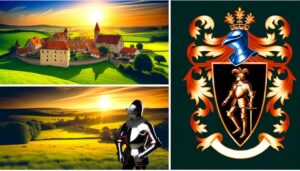
Heraldic symbols associated with the Sinclair family, such as the prominent engrailed cross and the stylized ship, provide a rich tapestry of historical significance and familial identity.
The engrailed cross, characterized by its indented edges, symbolizes protection and the enduring legacy of the Sinclairs in Scottish and Norman history. This emblem reflects the family's martial prowess and their long-standing role in defending territorial claims.
The stylized ship, often depicted in the Sinclairs' heraldry, signifies exploration, trade, and naval strength, underscoring their maritime heritage. Together, these symbols encapsulate the dual nature of the Sinclair family as both warriors and seafarers.
Analyzing these symbols reveals a deeper understanding of the Sinclairs' storied past and their contributions to European history.
Prominent Historical Figures
The Sinclair lineage boasts a roster of prominent historical figures whose contributions have left an indelible mark on European history. Ranging from medieval knights to influential politicians, the family's legacy is exemplified by the following prominent individuals:
- Henry Sinclair, Earl of Orkney: A 14th-century nobleman and explorer, credited with voyages to Greenland and possibly North America.
- William Sinclair, 1st Earl of Caithness: Renowned for his architectural patronage, notably the construction of the Roslin Chapel, a masterpiece of Gothic architecture.
- Catherine Sinclair: A 19th-century Scottish novelist and philanthropist, known for her literary works and efforts in social reform.
These figures underscore the diverse roles the Sinclairs played in shaping political, architectural, and cultural landscapes across centuries.
Cultural Impact
Throughout centuries, the Sinclair family's cultural impact has permeated various fields, including literature, architecture, and social reform, reflecting their profound influence and enduring legacy.
In literature, the Sinclairs have been immortalized in works such as Sir Walter Scott's novels, where they are often portrayed as emblematic figures of Scottish nobility.
Architecturally, the Sinclairs' patronage is evident in the construction of landmarks like Rosslyn Chapel, renowned for its intricate carvings and mysterious symbolism.
Social reform saw key Sinclair figures advocating for progressive change, particularly in the areas of education and workers' rights during the 19th century.
Their contributions have left an indelible mark, shaping cultural narratives and societal structures across generations.
Modern-Day Sinclair
Evolving from their storied past, the Sinclair family continues to play a significant role in contemporary society, actively engaging in various professional fields such as politics, business, and the arts. This legacy is evident in their ongoing contributions to multiple sectors, demonstrating adaptability and influence.
- Politics: Sinclairs have held significant governmental positions, shaping policy and governance.
- Business: Members of the Sinclair family have founded and led notable enterprises, impacting industries globally.
- Arts: The family name is associated with contributions to literature, music, and visual arts, enriching cultural heritage.
These modern-day pursuits highlight the enduring legacy of the Sinclair name, reflecting a blend of historical significance and contemporary relevance. The family's influence remains robust, demonstrating their adaptability and enduring impact.
Conclusion
The name Sinclair, steeped in the mists of time, embodies a rich tapestry woven from Norman, French, and Scottish threads. From its etymological roots to its heraldic symbols, the name has traversed centuries, leaving an indelible mark on history.
Prominent figures and cultural imprints underscore its enduring legacy. In the modern era, Sinclair continues to resonate, a living evidence to the complex interplay of cultural and historical forces.