Robertson Name Meaning and Origin
The surname Robertson originates from the given name Robert, derived from Old Germanic elements 'hrod' (fame) and 'beraht' (bright), meaning 'famed for brightness' or 'illustrious.' The suffix '-son' indicates 'son of Robert,' signifying lineage. Historically prominent in Scotland, particularly linked to Clan Donnachaidh and the legacy of 13th-century king Duncan I, the name reflects leadership and loyalty.
It is widespread in Scotland and has significant presence in North America, Australia, and New Zealand due to British colonial expansion. The name has marked cultural impact across literature, sports, politics, and science.
Discover more about its extensive influence and historical journeys.
Key Takeaways
- The surname Robertson means 'son of Robert,' originating from the Old Germanic name Robert meaning 'famed for brightness.'
- It is historically prominent in Scotland and linked to Clan Donnachaidh, with ancestry tracing back to King Duncan I.
- The name Robertson reflects heritage and lineage, indicating descent from someone named Robert.
- Geographic distribution includes Scotland, North America, and regions influenced by British colonial expansion.
- Notable individuals with the surname Robertson have excelled in literature, sports, politics, and science.
Etymology of Robertson
The surname Robertson originates from the given name Robert, which itself is derived from the Old Germanic elements 'hrod,' meaning 'fame,' and 'beraht,' meaning 'bright.' The name Robert signifies someone who is 'famed for their brightness' or 'illustrious.'
The suffix '-son' in Robertson is a patronymic addition, indicating 'son of Robert.' This construction conveys lineage and familial heritage, a common practice in many European cultures to denote descent.
The etymological roots highlight the name's blend of personal achievement and ancestral pride. In addition, the integration of Germanic elements reflects broader linguistic influences that shaped early English surnames, emphasizing the interconnected nature of language evolution and societal norms in surname formation.
Historical Roots
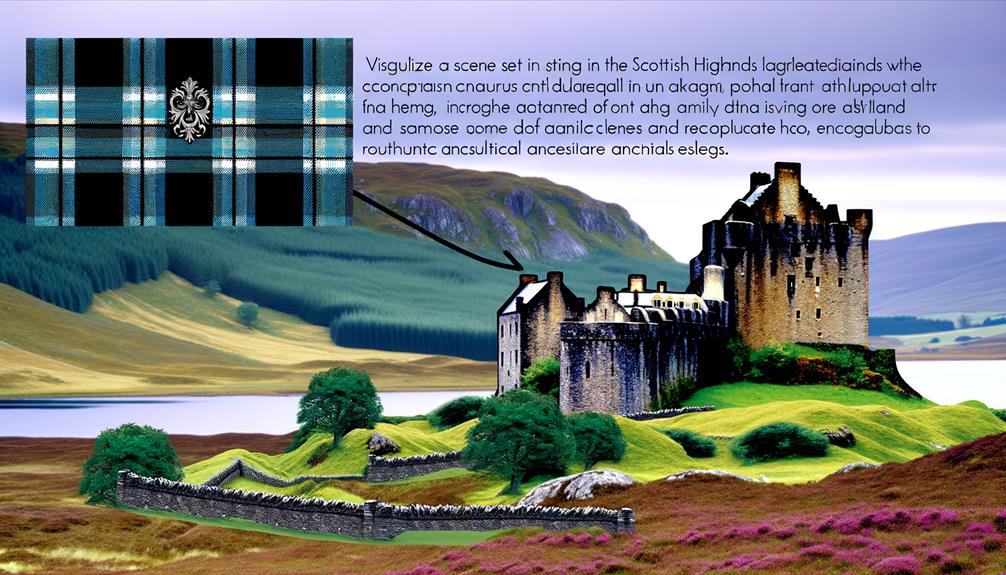
Tracing the historical roots of the Robertson surname reveals its prominence in Scotland, particularly in the Highlands, where clan-based societies flourished and surnames served as essential indicators of familial affiliations and social standing.
The Robertson name is intrinsically linked to Clan Donnachaidh, also known as Clan Robertson, which claims descent from the 13th-century Scottish king, Duncan I. This lineage underscores the clan's historical significance and its deep-seated ties to Scottish nobility.
During the Wars of Scottish Independence, Clan Robertson played a pivotal role, further solidifying its historical importance. The clan's resilience and strategic alliances have enabled the Robertson name to endure through centuries, reflecting a legacy of leadership, loyalty, and influence within the intricate tapestry of Scottish history.
Geographic Distribution
Geographic distribution of the Robertson surname reveals its widespread presence not just in Scotland but also in various parts of the world, reflecting patterns of migration, colonization, and diaspora. In Scotland, the name is mainly found in the Highlands and the Lowlands, mirroring historical clan territories.
Outside Scotland, significant populations of Robertsons are located in North America, particularly in the United States and Canada, due to 18th and 19th-century migrations. Australia and New Zealand also have notable Robertson communities, a result of British colonial expansion.
The surname's dispersal illustrates broader socio-historical movements, including the Highland Clearances and economic migrations, underscoring how socio-political forces shape familial and cultural identities globally.
Notable Robertsons
Among the diaspora of the Robertson surname, several individuals have achieved notable prominence in various fields, reflecting the diverse contributions of this widespread family lineage.
In literature, James Robertson, a Scottish novelist, has garnered acclaim for his historical narratives.
In sports, Oscar Robertson, an American basketball player, is lauded for his groundbreaking achievements, including being the first player to average a triple-double for an entire season.
Political arenas have seen figures like Pat Robertson, an influential televangelist and political commentator.
In science, Howard P. Robertson made significant advancements in mathematical physics.
These examples underscore the multifaceted impact of the Robertson name across different domains, illustrating a legacy of excellence and achievement.
Cultural Impact
The Robertson surname has permeated various cultural domains, influencing literature, sports, politics, and science, thereby shaping societal narratives and collective memory in profound ways.
In literature, authors like James Robertson have enriched Scottish literary tradition.
Sports figures such as Oscar Robertson have left indelible marks in basketball history.
Politically, the Robertson name resonates with influential figures like Pat Robertson, who had a significant impact on American evangelical and political landscapes.
Scientific contributions are seen through individuals like Howard P. Robertson, whose work in physics and cosmology provided valuable insights into the universe's structure.
Each field's contributions underscore the Robertson surname's multifaceted impact, demonstrating how individuals bearing this name have shaped diverse aspects of global culture and knowledge.
Conclusion
The Robertson surname, with its roots deeply embedded in the etymology of 'son of Robert,' has traversed centuries to become an emblem of historical significance. From its origins in Scotland to its widespread geographic distribution, the name has been carried by countless notable figures, leaving an indelible mark on culture and society.
The cultural impact of the Robertson name is nothing short of monumental, epitomizing the enduring legacy of familial lineage and historical resonance.