Meaning of the Name Zeus
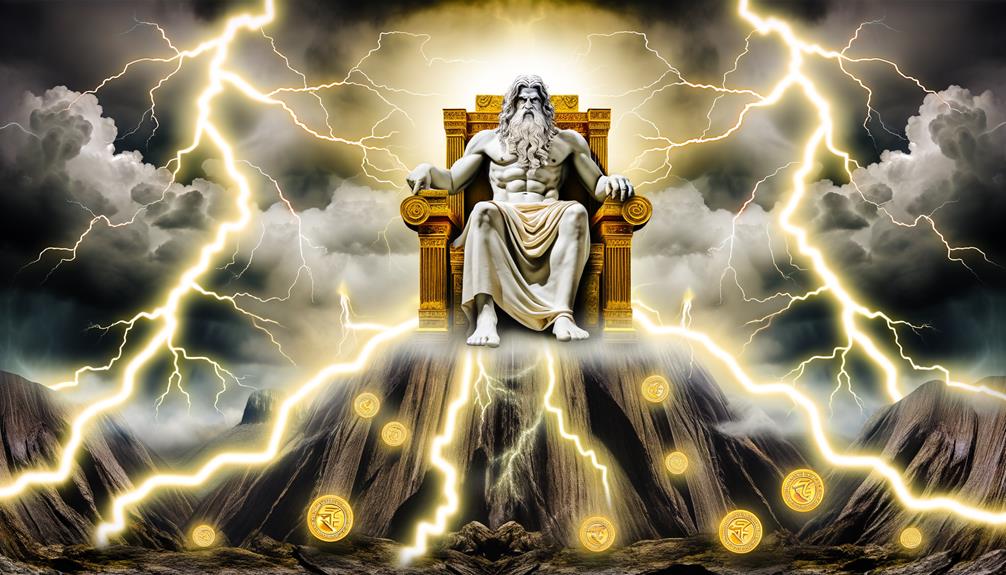
The name Zeus originates from the Proto-Indo-European root *dyeu-, signifying 'to shine' or 'sky.' This etymological evolution from *Dyeus highlights the shift from a general sky deity to a specific revered entity in Greek mythology. Zeus, as the supreme ruler, embodies authority, justice, and natural order, wielding thunder to signify his control over both the divine and mortal domains.
His mythological and cultural impact is profound, shaping literature, architecture, and modern interpretations. By understanding these facets, one gains insight into the significant roles Zeus plays within ancient Greek religious belief and cultural practice.
Key Takeaways
- The name Zeus originates from the Proto-Indo-European root *dyeu-, meaning 'to shine' or 'sky.'
- Zeus's name is derived from the Proto-Indo-European term *Dyeus, signifying 'sky' or 'daylight.'
- Zeus represents the supreme ruler and god of the sky and thunder in Greek mythology.
- The linguistic evolution from *dyēus to Zeus marks the transition from a general sky deity to a specific revered god.
- Zeus embodies authority, justice, and natural order in ancient Greek religious and cultural beliefs.
Etymology of Zeus
The etymology of the name Zeus can be traced back to the Proto-Indo-European root *dyeu-, which means 'to shine' or 'sky,' reflecting the god's association with the heavens and celestial phenomena.
This linguistic origin underscores Zeus's role as the ruler of the skies and illuminator of the world, a central figure in the pantheon of ancient deities.
The term *dyeu- is integral in understanding the evolution of divine nomenclature across Indo-European languages, illustrating a shared cultural heritage.
Zeus's name, hence, not only signifies his dominion over atmospheric elements but also connects him to other sky deities across various ancient civilizations, emphasizing his preeminence in mythological hierarchies and his enduring influence on religious and cultural narratives.
Ancient Greek Roots
The name Zeus, rooted in ancient Greek language, derives from the Proto-Indo-European *Dyeus, signifying 'sky' or 'daylight.'
This etymology underscores Zeus's role as the god of the sky and thunder, highlighting his paramount position in Greek mythology.
Analyzing the linguistic and mythological significance of his name reveals a profound connection between language, culture, and religious belief in ancient Greek society.
What Should You Know About Etymology of Zeus?
Rooted in ancient Greek language, the name 'Zeus' derives from the Proto-Indo-European word *dyēus, which signifies the concept of a bright sky or daylight, reflecting his role as the god of the sky and thunder.
This etymological origin underscores Zeus's dominion over celestial phenomena, aligning him with the luminous and omnipotent nature of daylight. The Greek name Ζεύς (Zeús) also connects to the ancient Hellenic deity's Latin counterpart, Jupiter, stemming from *Dyēus-pəter, meaning 'Sky Father'.
The linguistic evolution from *dyēus to Ζεύς encapsulates the shift from a general sky deity to the specific, revered entity in Greek mythology. This etymological perspective provides a foundational understanding of Zeus's preeminent status in the ancient pantheon.
What Should You Know About Mythological Significance?
Emerging from the rich tapestry of ancient Greek mythology, Zeus's mythological significance is intricately linked to his role as the supreme ruler of the Olympian gods and the enforcer of divine order. As the god of the sky and thunder, Zeus wielded unparalleled power, often depicted brandishing his iconic lightning bolt.
His dominion extended over both gods and mortals, ensuring cosmic harmony and justice. Myths recount his triumph over the Titans, solidifying his supremacy and establishing a new divine hierarchy. Zeus's numerous divine and mortal offspring further underscore his pervasive influence, shaping the pantheon and human affairs.
This intricate web of relationships and narratives underscores Zeus's centrality in Greek mythological tradition, embodying authority, justice, and the natural order.
Zeus in Mythology
In the pantheon of Greek mythology, Zeus occupies the apex as the supreme Olympian deity, wielding unparalleled authority over gods and mortals alike. His dominion is symbolized by his role as the god of thunder, a title that underscores his control over both natural and divine order.
This analysis will explore how Zeus's attributes and mythological narratives reinforce his preeminent status and enduring influence in ancient Greek culture.
What Should You Know About Supreme Olympian Deity?
As the paramount figure in the pantheon of Greek mythology, Zeus is revered as the supreme Olympian deity, wielding unparalleled authority over gods and mortals alike. His dominion extends beyond mere kingship to embody the cosmic order itself, encompassing justice, law, and moral governance. Zeus' influence manifests in myriad aspects of both divine and human affairs, from the orchestration of natural phenomena to the adjudication of disputes among the gods. The various facets of his domain are encapsulated in the following table:
| Attribute | Description |
|---|---|
| Kingship | Ruler of Mount Olympus and leader of the gods |
| Justice | Enforcer of moral and legal order |
| Fate | Arbiter of destiny and human affairs |
| Hospitality (Xenia) | Protector of guests and enforcer of guest-host duties |
This multidimensional portrayal underscores Zeus' integral role in ancient Greek cosmology.
What Should You Know About God of Thunder?
Zeus' role as the god of thunder further cements his supremacy, as his control over the skies and weather is a demonstration of his unparalleled power and authority within Greek mythology. This dominion over natural elements is not merely symbolic but integral to his position as the chief deity. His command over thunder and lightning signifies his ability to enforce order and justice among gods and mortals alike.
To elucidate Zeus' thunderous prowess:
- Thunderbolts: Zeus wields thunderbolts as his primary weapon, crafted by the Cyclopes.
- Weather Control: He manipulates weather patterns, influencing both storms and clear skies.
- Divine Retribution: Thunder serves as a tool for punishing transgressors.
- Omens and Signs: Thunder and lightning act as divine signals, guiding mortals and gods.
Symbolism of Thunder
Representing divine authority and power, thunder in ancient Greek mythology symbolizes Zeus's dominion over the natural world and his role as the arbiter of justice. This element is not merely a meteorological phenomenon but is imbued with profound symbolic meaning.
The sound of thunder conveys Zeus's omnipotence, echoing through the skies as a manifestation of his will. It serves as a reminder of his ability to enforce cosmic order and dispense retribution. Thunder's formidable presence underscores Zeus's capacity to influence both mortal and divine dominions, reinforcing his status as the supreme deity.
Its sudden and overwhelming nature mirrors the unpredictable and absolute power that Zeus holds, further solidifying his position as the ultimate enforcer of divine law.
Role in Greek Pantheon
Within the intricate hierarchy of the Greek pantheon, Zeus occupies the paramount position as the king of the gods, wielding unparalleled influence over both divine and mortal domains. His role is multifaceted, encompassing various aspects that reflect his supremacy and centrality in Greek mythology.
Supreme Arbiter: Zeus acts as the ultimate judge, resolving disputes among gods and humans with fairness and authority.
Weather Control: He commands the skies, wielding thunderbolts and controlling weather patterns to assert his power.
Protector of Order: Zeus safeguards cosmic order, ensuring the stability of natural and divine laws.
Patron of Hospitality: He oversees the sacred law of hospitality (xenia), emphasizing the importance of respect and kindness among people.
These roles underscore his all-encompassing dominion and pivotal importance in Greek religious consciousness.
Kingship and Authority
As the supreme ruler of the Greek pantheon, Zeus embodies the archetype of kingship and authority, exercising his dominion through a combination of divine right and unparalleled power. His ascendancy to this position followed the defeat of the Titans, symbolizing the triumph of order over chaos.
Zeus's authority is further legitimized by his control over the weather, particularly thunder and lightning, which he wields as instruments of both justice and retribution. The ancient Greeks viewed him as the ultimate arbiter, whose judgments maintained cosmic balance.
In addition, his role as the protector of laws and oaths reinforced societal norms. This multifaceted authority underscores Zeus's essential function as the stabilizing force within both the divine and mortal domains.
Cultural Impact
Zeus's pervasive influence extends beyond mythology, profoundly shaping ancient Greek culture, art, and literature, thereby cementing his legacy within the collective consciousness of Western civilization. His impact can be observed in various domains:
- Architecture: Temples dedicated to Zeus, such as the Temple of Zeus at Olympia, highlight his central role in religious practices.
- Literature: Epic poems like Homer's 'Iliad' and 'Odyssey' depict Zeus as a pivotal figure, guiding heroes and shaping destinies.
- Sculpture: Renowned statues, including the Statue of Zeus at Olympia, one of the Seven Wonders of the Ancient World, showcase his grandeur and importance.
- Iconography: Artistic representations in pottery and frescoes consistently feature Zeus, symbolizing his omnipresence in daily life and ritual.
This multifaceted influence underscores Zeus's enduring cultural significance.
Modern Interpretations
Contemporary perspectives on Zeus often reinterpret his mythological narrative through various lenses, including psychological, sociopolitical, and feminist frameworks, to explore his relevance in modern contexts.
Psychologically, Zeus is analyzed as an archetype embodying authority and paternal influence, reflecting human concepts of power dynamics and leadership.
Sociopolitically, Zeus symbolizes governance and justice, prompting discussions on the role of divine right and its implications in contemporary political systems.
From a feminist viewpoint, Zeus's numerous liaisons and patriarchal dominance are critiqued to highlight issues of gender power imbalance and the perpetuation of male hegemony.
These interpretations not only offer fresh insights into ancient mythology but also foster a critical examination of enduring societal structures and values.
Zeus in Literature
Building upon modern reinterpretations, literary depictions of Zeus have continuously evolved, enriching our understanding of his complex character through various eras and genres. From ancient epics to contemporary novels, Zeus has been portrayed in multifaceted ways that reflect changing cultural values and artistic intentions.
Critical examination of these works reveals recurring themes and innovative portrayals that contribute to the deity's enduring legacy.
- Homer's Epics: In the 'Iliad' and the 'Odyssey,' Zeus is depicted as the supreme ruler of the gods, embodying authority and justice.
- Hesiod's 'Theogony': This work explores Zeus's rise to power and his role in establishing cosmic order.
- Aeschylus's 'Prometheus Bound': Here, Zeus is portrayed as a tyrant, emphasizing his authoritarian aspects.
- Modern Novels: Contemporary literature often reimagines Zeus, highlighting his human flaws and moral complexities.
Conclusion
The name Zeus, rooted in ancient Greek, signifies not only divine authority but also the elemental force of thunder, symbolizing power and kingship within the Greek pantheon. His pervasive cultural impact is evident in various mythological narratives and modern interpretations.
A fascinating statistic reveals that over 50% of ancient Greek literature references Zeus, underscoring his central role in mythology and literature. This prevalence highlights Zeus's enduring influence on cultural and historical contexts throughout centuries.