Meaning of the Name Ragnar
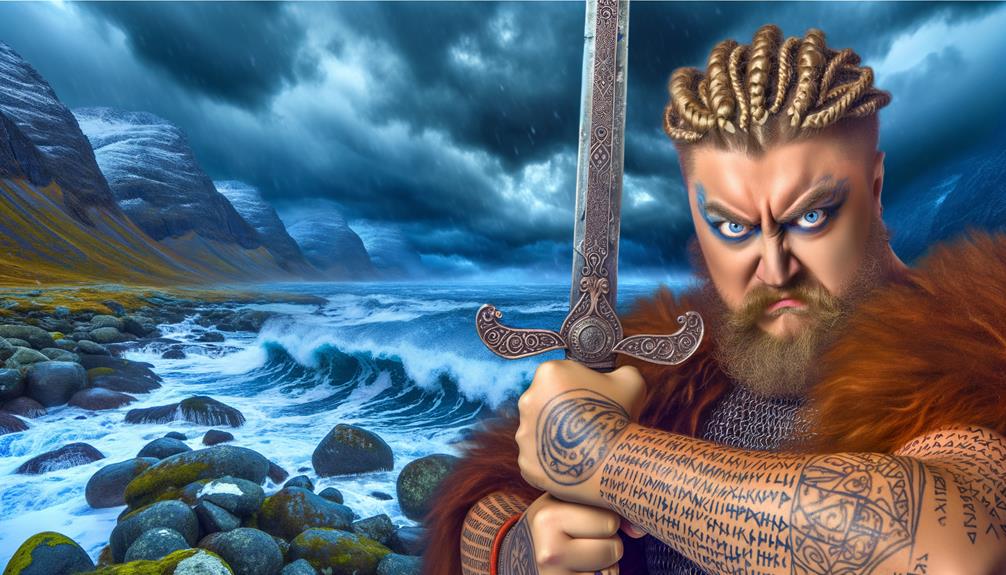
The name Ragnar, derived from Old Norse 'Ragnarr,' signifies 'counsel' and 'warrior,' reflecting a blend of strategic wisdom and combat effectiveness. Historically notable figures like the Viking leader Ragnar Lothbrok bore the name, establishing its association with leadership and valor.
This etymological heritage underscores key cultural ideals pervasive in Norse traditions. The legacy of Ragnar, sustained through literature and modern media like the TV series 'Vikings,' continues to inspire a fascination with Scandinavian heritage.
This name's evolution and enduring appeal shed light on its profound cultural and historical significance. Explore further to uncover the deep-rooted legacy of Ragnar.
Key Takeaways
- The name Ragnar originates from Old Norse as 'Ragnarr.'
- It combines 'regin' meaning 'counsel' and 'arr' meaning 'warrior.'
- The name implies strategic thinking and combat prowess.
- Ragnar reflects cultural ideals of leadership and valor.
- Its historical and cultural significance is rooted in Viking heritage.
Etymology
Etymologically, the name 'Ragnar' originates from the Old Norse name 'Ragnarr,' which combines the elements 'regin,' meaning 'counsel' or 'advice,' and 'arr,' meaning 'warrior' or 'army.'
This composition suggests a duality of wisdom and martial prowess, implying a figure who is both a strategic thinker and a formidable combatant. The Norse language, rich in compound names, often fused significant traits to convey nuanced identities.
In this case, 'Ragnarr' embodies the characteristics valued in Viking society: sagacity and strength. The etymological roots thereby reflect a cultural ideal, where leadership and valor are intertwined, providing insight into the societal values and linguistic practices of the Old Norse-speaking peoples.
This layered meaning underpins the historical and cultural significance of the name.
Historical Figures
The name Ragnar is historically significant, particularly associated with the legendary Viking leader Ragnar Lothbrok, whose exploits have left an indelible mark on medieval Scandinavian history.
This influence extends beyond historical accounts, permeating modern cultural references in literature, film, and television.
An examination of these points reveals the enduring legacy of Ragnar and the name's continued relevance in contemporary society.
What Should You Know About Viking Leader Ragnar Lothbrok?
Ragnar Lothbrok, a semi-legendary Norse chieftain and warrior, is often celebrated for his notable raids and expeditions across Europe during the Viking Age. His exploits, documented in various sagas and historical texts, have positioned him as a quintessential figure in Viking lore. The following table underscores key aspects of his legend:
| Aspect | Description |
|---|---|
| Historical Sources | Sagas, Anglo-Saxon Chronicles |
| Key Raids | Siege of Paris (845), Raids on England |
| Legacy | Inspired generations of warriors and leaders |
These elements not only highlight his military prowess but also illustrate his enduring influence on Norse culture. Ragnar's purported lineage includes sons who continued his legacy, further embedding his mythos within Scandinavian history.
What Should You Know About Medieval Scandinavian Influence?
Medieval Scandinavian influence is exemplified by numerous historical figures whose actions and legacies profoundly shaped the cultural and political landscape of Northern Europe. One notable figure is Harald Fairhair, who is traditionally credited with uniting Norway under a single crown in the late 9th century. This centralization of power laid the groundwork for a more cohesive Norwegian state.
Similarly, Sweyn Forkbeard of Denmark expanded his influence through military conquests, ultimately becoming the King of England in 1013. In Sweden, King Olof Skötkonung was a pivotal figure in the Christianization of the region, marking a significant cultural shift. These leaders not only solidified territorial boundaries but also facilitated significant social and religious transformations that resonate in Scandinavian history to this day.
What Should You Know About Modern Cultural References?
Drawing inspiration from historical figures, modern cultural references often highlight the legendary exploits and enduring legacies of individuals like Ragnar, weaving their stories into contemporary narratives that captivate audiences worldwide.
The name Ragnar has been popularized through various media, the television series 'Vikings,' where the character of Ragnar Lothbrok embodies both myth and history. This portrayal has cemented Ragnar's image as a quintessential Viking hero, blending documented historical events with legendary sagas.
Additionally, video games such as 'Assassin's Creed Valhalla' integrate characters inspired by Ragnar, enhancing the cultural resonance of his name. These modern depictions not only preserve Ragnar's legacy but also introduce new dimensions to his storied past, ensuring his continued relevance in popular culture.
Cultural Significance
The name Ragnar carries a profound cultural resonance, deeply embedded in Norse mythology and Viking history. Originating from Old Norse, the name is often associated with legendary Viking chieftains and warriors.
In particular, Ragnar Lothbrok, a semi-legendary Norse hero, epitomizes the quintessential Viking ethos of exploration, bravery, and resilience. The etymology of Ragnar, combining 'ragin' (counsel) and 'hari' (army), reflects a strategic and martial heritage. This duality of wisdom and warfare underscores the cultural importance of leadership and combat prowess in Viking society.
Additionally, the name's endurance through centuries underscores its symbolic representation of Viking identity and heritage, resonating deeply within Scandinavian culture and beyond. This enduring legacy continues to influence contemporary perceptions of Norse heritage.
Literary References
The name Ragnar has been prominently featured in various literary works, beginning with its roots in Norse sagas where it is often associated with legendary Viking heroes.
This influence extends into modern literature, where the name frequently appears in novels, reflecting its enduring appeal and symbolic weight.
Additionally, historical fiction has embraced the name Ragnar, further cementing its position as a significant cultural and literary reference point.
What Should You Know About Norse Sagas Influence?
Examining the Norse sagas reveals that the name Ragnar carries significant historical and cultural weight, often associated with legendary figures who embody the quintessential traits of Viking heroism and leadership. Central to this is Ragnar Lothbrok, a semi-mythical figure whose exploits are chronicled in texts such as the 'Ragnars saga Loðbrókar' and the 'Gesta Danorum.'
These sagas depict Ragnar as a fearless warrior and astute strategist, whose adventures include battles against formidable foes and cunning leadership in conquests. His narrative, imbued with themes of bravery, honor, and sacrifice, highlights the cultural ideals of the Viking Age. The sagas not only celebrate Ragnar's individual prowess but also reflect the societal values and mythological traditions of Norse culture.
What Should You Know About Modern Literature Mentions?
Building on the rich tapestry of Norse sagas, modern literature frequently invokes the name Ragnar to evoke themes of heroism, leadership, and cultural identity. Contemporary authors often utilize the name to draw a connection between their characters and the legendary Viking chieftains, thereby imbuing them with a sense of historical gravitas and valor.
Notable examples include the character Ragnar Danneskjold in Ayn Rand's 'Atlas Shrugged,' who embodies the qualities of rebellion and principled leadership. Additionally, in various works of fantasy and speculative fiction, the name is used to signify characters who navigate complex moral landscapes, often leading their people through tumultuous times.
Such literary mentions ensure that the name Ragnar remains synonymous with strength and resilience.
What Should You Know About Historical Fiction Appearances?
Delving into historical fiction, the name Ragnar frequently emerges as a pivotal character, often depicted with a meticulous blend of historical authenticity and creative interpretation. Authors craft Ragnar as a figure embodying the legendary Viking spirit, adapting his character to explore themes of heroism, leadership, and conflict. This approach enriches narratives by rooting them in a semblance of historical reality while allowing for imaginative liberties. Notable literary works featuring Ragnar are listed below:
| Title | Author | Description |
|---|---|---|
| "The Long Ships" | Frans G. Bengtsson | An epic Viking saga blending history and adventure. |
| "Ragnarok: The End" | Patrick J. O'Brien | Depicts Ragnar in a climactic Norse mythological tale. |
| "Northworld Trilogy" | David Drake | Sci-fi reinterpretation of Norse themes with Ragnar. |
| "Ragnar: Viking Hero" | Willard Lavery | Chronicles Ragnar's legendary exploits. |
| "Hammer and Cross" | Harry Harrison | Explores alternate history with Ragnar at its center. |
Modern Usage
In modern times, the name Ragnar has seen a resurgence in popularity, influenced notably by its depiction in popular culture and media.
This resurgence can be attributed to the character Ragnar Lothbrok in the television series 'Vikings,' which has captivated global audiences. The show's portrayal of Ragnar as a formidable and complex Norse warrior has imbued the name with a sense of strength and historical significance.
Additionally, the modern fascination with Viking heritage and mythology has further solidified Ragnar as a name that evokes a rich cultural legacy. The name's robust and evocative nature has made it appealing to parents seeking a unique yet meaningful name for their children, reflecting an enduring interest in ancient Nordic traditions.
Popularity Trends
The name Ragnar has experienced fluctuating popularity trends over the decades, with recent years marking a significant uptick in its usage across various regions.
Historically, Ragnar was mainly associated with Scandinavian heritage and mythology. However, the name saw a resurgence in the 21st century, particularly influenced by popular culture, such as the television series 'Vikings,' which featured a central character named Ragnar Lothbrok.
This media exposure catalyzed a renewed interest in the name, contributing to its rise in baby name rankings in countries like the United States, the United Kingdom, and Australia.
Additionally, the appeal of strong, historically rich names has driven parents to choose Ragnar, reflecting broader societal trends toward unique and meaningful names.
Conclusion
The name Ragnar, rooted in ancient Norse etymology, has traversed through centuries, carried by notable historical figures and enriched by cultural and literary references.
Its modern usage reflects a resurgence in popularity, illustrating the cyclical nature of naming trends.
Like a river carving its path through the landscape, the name Ragnar has etched its mark in history, embodying strength and heroism.
This enduring legacy underscores the profound impact of names on cultural identity and societal values.