Meaning of the Name Eowyn
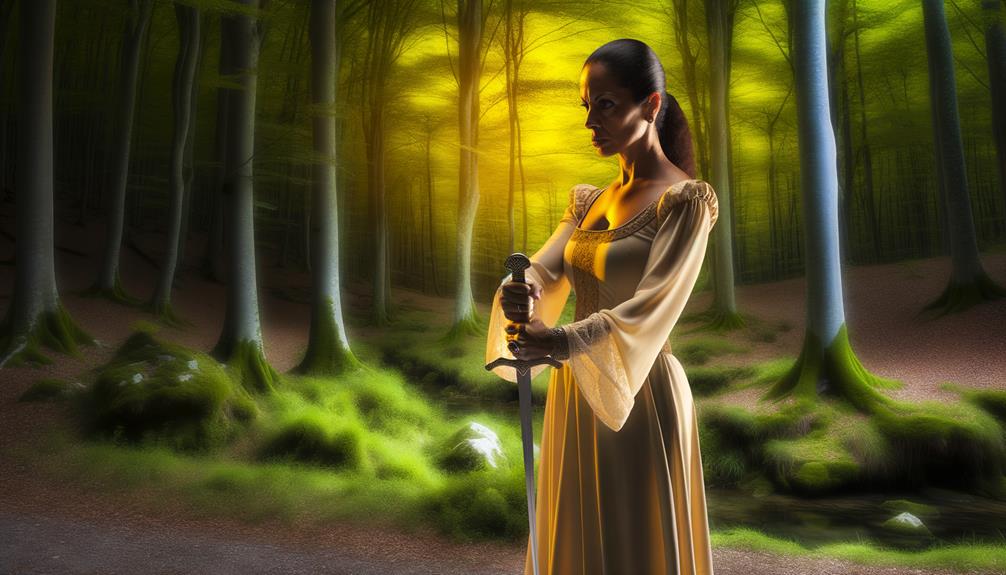
The name Eowyn derives from Old English elements 'ēoh,' meaning 'horse,' and 'wyn,' meaning 'joy.' Phonetically, it combines these elements to evoke equine grace and delight. This etymology reflects the cultural heritage of the Rohirrim, a people inspired by Anglo-Saxon traditions in Tolkien's Middle-earth.
The name embodies their reverence for horses and their pastoral lifestyle. Eowyn's name not only signifies strength and elegance but also serves as a linguistic bridge to her identity and heritage.
For a deeper exploration of the name's cultural significance, linguistic roots, and its impact on literature, further insights await.
Key Takeaways
- Eowyn's name combines Old English elements 'eoh' (horse) and 'wyn' (joy).
- The name signifies equine grace, happiness, and nobility.
- Etymologically, 'Eowyn' reflects the Rohirrim's values and cultural heritage.
- Phonetically, 'Eowyn' maintains Old English pronunciation, evoking elegance.
- The name embodies the Rohirrim's reverence for horses and pastoral lifestyle.
Etymology of Eowyn
The name Eowyn, frequently analyzed within the field of literary onomastics, derives from the Old English elements 'ēoh,' meaning 'horse,' and 'wyn,' signifying 'joy' or 'delight.'
This etymological construction reflects a phonetic amalgamation where 'ēoh' (pronounced /ɛə̯x/) and 'wyn' (pronounced /wɪn/) coalesce to form Eowyn (pronounced /ˈɛɔ̯wɪn/).
The semantic fusion of these terms evokes imagery of equine grace coupled with a sense of happiness, a fitting attribution given the character's valorous and spirited nature.
This lexical origin underscores the thematic resonance between name and narrative, illustrating how J.R.R. Tolkien's linguistic expertise enhances the depth of his characters.
Such etymological insights enrich our comprehension of the literary tapestry within which Eowyn exists.
Historical Context
In the historical context of Tolkien's Middle-earth, Eowyn's name reflects the cultural and linguistic heritage of the Rohirrim, a society deeply connected to their equestrian traditions.
The Rohirrim, also known as the Horse-lords, spoke a language influenced by Old English, mirroring their Anglo-Saxon inspiration.
Eowyn's name comprises the elements 'éo,' meaning 'horse,' and 'wyn,' translating to 'joy' or 'delight.' The phonetic structure of 'Éowyn' (pronounced [ˈe.o.wɪn]) embodies the thematic essence of the Rohirrim's reverence for horses and their pastoral lifestyle.
The name's etymology underscores the historical and cultural emphasis placed on equine symbolism, reflecting the societal values and linguistic evolution present within the Rohirrim's heritage.
Cultural Significance
Reflecting the profound cultural resonance within Tolkien's narrative, Eowyn's name encapsulates the Rohirrim's intrinsic values and their veneration of equine qualities. Etymologically, the name 'Eowyn' derives from Old English elements: 'eoh' meaning 'horse,' and 'wyn' signifying 'joy' or 'pleasure.' This connotation highlights the Rohirrim's deep connection to their horses, central to their identity and societal structure.
Phonetically, 'Eowyn' (/ˈe.oʊ.wɪn/) conveys a sense of elegance and strength, mirroring her character in the story. Eowyn's name, as such, is not merely a designation but a symbol of cultural ethos, embodying the valor, freedom, and nobility esteemed by her people. It serves as a linguistic bridge between her identity and the heritage she represents.
Linguistic Analysis
Eowyn's name, derived from Old English, combines 'eoh' (horse) and 'wyn' (joy), illustrating a profound linguistic synthesis that underscores her cultural and personal identity.
The root 'eoh' traces back to Proto-Germanic *ehwaz, denoting a horse, a symbol of nobility and freedom in Anglo-Saxon culture. 'Wyn' emerges from Proto-Germanic *wunjō, meaning joy or delight.
Phonetically, 'Eowyn' is articulated as /ˈeɔːwɪn/, maintaining the diphthong 'eo' characteristic of Old English pronunciation. This nomenclature not only reflects semantic depth but also phonological heritage, preserving the linguistic intricacies of the language.
The amalgamation of these elements encapsulates the essence of her character, merging equine nobility with an intrinsic sense of joy and valor.
Legacy and Influence
The etymological richness and phonetic heritage of Eowyn's name have transcended literary boundaries, influencing modern interpretations of character nomenclature and cultural representation. Derived from Old English elements 'eoh' (horse) and 'wyn' (joy), Eowyn's name encapsulates both semantic depth and melodic quality.
This dual significance has rendered the name emblematic of strength and elegance, permeating through various forms of media and scholarly discourse. In contemporary contexts, Eowyn is frequently cited as a paragon of complex character design, inspiring creators to embed linguistic and cultural subtleties within names.
Her legacy underscores the importance of etymological awareness in character development, fostering a nuanced understanding of how names can shape and enhance narrative resonance and identity.
Conclusion
Eowyn, a name birthed from the fertile soil of J.R.R. Tolkien's linguistic creativity, stands as a beacon of Old English heritage, embodying strength and valor.
Its roots, interwoven with historical and cultural threads, reveal a tapestry rich in meaning and significance.
The phonetic melody of 'Eowyn' resonates through time, leaving an indelible mark on the literary and cultural landscapes.
Therefore, Eowyn endures, a timeless symbol of resilience and noble spirit in the annals of fantasy literature.