Meaning of the Name Elton
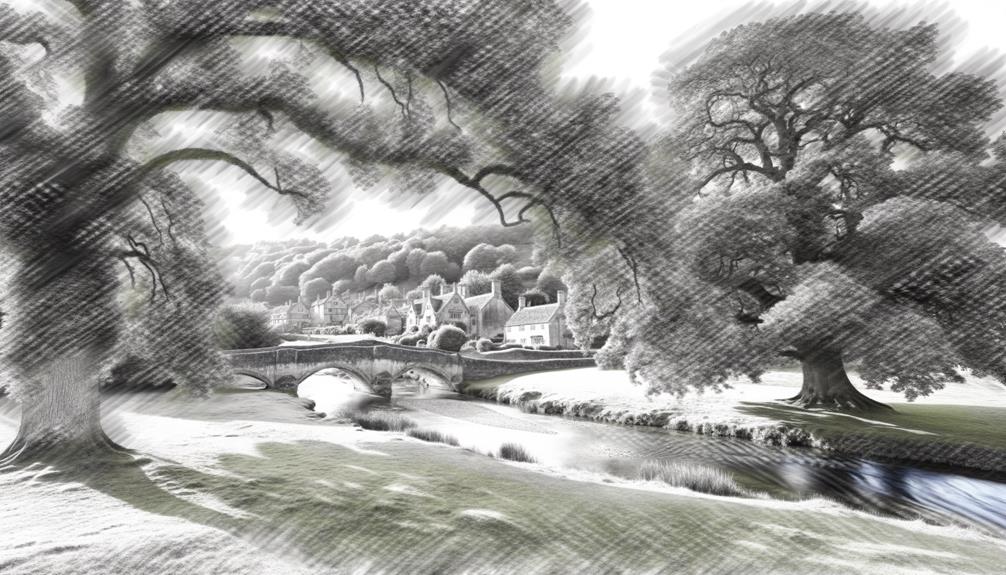
The name Elton, derived from Old English, merges 'ælf' meaning 'elf' with 'tūn' meaning 'enclosure' or 'settlement.' Historically, the name referred to an enchanted settlement, deeply rooted in Anglo-Saxon mythology and culture. Over the centuries, Elton symbolized noble and significant locations, often administrative or trading hubs.
The name gained contemporary recognition through notable figures such as Sir Elton John. Variations and diminutives of the name reflect its adaptability across different cultures and time periods.
If you're intrigued by these historical and cultural nuances, much more awaits in the full exploration.
Key Takeaways
- The name Elton originates from Old English, combining 'ælf' (elf) and 'tūn' (enclosure or settlement).
- 'Ælf' refers to wise and beautiful supernatural beings in Anglo-Saxon mythology.
- Elton historically denoted a mythical or enchanted settlement in Anglo-Saxon communities.
- The name symbolizes nobility and settlement, reflecting cultural and geographical significance.
- Famous bearers like Sir Elton John have influenced the name's modern perception and popularity.
Origins in Old English
The name Elton finds its origins in Old English, deriving from the elements 'ælf,' meaning 'elf,' and 'tūn,' meaning 'enclosure' or 'settlement.'
This combination suggests a place associated with elves, which were significant in Anglo-Saxon mythology and folklore. The term 'ælf' connotes supernatural beings of great beauty and wisdom, often considered guardians of nature.
The suffix 'tūn' was commonly used to denote a village or a farmstead, indicating a settled area. Consequently, the name Elton likely referred to a mythical or enchanted settlement.
Linguistically, the name encapsulates a blend of cultural mythology and geographical terminology, reflecting the synthesis of mystical and mundane elements prevalent in early English naming conventions.
Historical Significance
Elton's historical significance is rooted in its usage among Anglo-Saxon communities, where it often denoted locations of social and cultural importance. In medieval England, the name 'Elton' was commonly associated with settlements or towns, as indicated by the Old English elements 'ælf' (elf) and 'tūn' (enclosure or settlement).
These locales frequently served as administrative or trading hubs, reflecting their crucial roles in regional governance and economic exchanges. Historical records reveal that such settlements were often strategically situated near essential resources or trade routes, underscoring their integral function in sustaining the socio-economic fabric of the time.
The recurrence of the name in ancient charters and land grants further attests to its enduring legacy and relevance in the historical narrative of early English society.
Cultural Interpretations
Cultural interpretations of the name Elton have evolved remarkably over time, reflecting both historical and modern influences. Historically, the name has appeared in various global contexts, often carrying connotations related to nobility and settlement.
In contemporary culture, Elton has gained prominence through notable figures such as Elton John, thereby influencing its perception and popularity.
What Should You Know About Historical Significance Globally?
Tracing its origins back to Old English roots, the name Elton has evolved through varied cultural interpretations across different historical periods and regions.
Initially derived from the Old English elements 'ætheling,' meaning noble, and 'tun,' meaning settlement or enclosure, Elton denoted a locale of high social standing. In medieval England, it often referred to a person hailing from such a place.
The name also found resonance in Scandinavian regions due to Viking influences, where it was adapted into local contexts.
In subsequent centuries, Elton's usage spread across Europe and into the Americas, symbolizing heritage and aristocracy.
This cross-cultural journey underscores the name's enduring appeal and adaptability, reflecting shifts in societal structures and cultural exchanges.
What Should You Know About Modern Cultural References?
Building upon its historical significance, the name Elton has found renewed prominence in modern culture through various notable figures and media representations. Most prominently, Sir Elton John, the legendary musician, has cemented the name's association with artistic genius and cultural influence. His contributions to music and philanthropy have given the name a global, positive connotation.
Additionally, the name appears in literature and cinema, often symbolizing a character of distinction or intellect. In popular media, the name Elton is frequently chosen for characters that convey sophistication or creativity, further embedding it in contemporary cultural consciousness. This modern usage reflects an ongoing evolution, where historical roots and contemporary significance coalesce to shape the name's current cultural interpretation.
Famous Bearers
Among the most notable individuals bearing the name Elton is Sir Elton John, the iconic British musician whose contributions to music and philanthropy have left an indelible mark on popular culture. His illustrious career spanning over five decades has solidified his status as a global legend.
Other prominent individuals named Elton include:
- Elton Mayo: An Australian psychologist known for his pioneering work in industrial sociology and organizational theory.
- Elton Brand: A former professional basketball player and current executive in the NBA, recognized for his achievements on and off the court.
- Elton Gallegly: A former U.S. Congressman who served California's 24th district, contributing to American legislative processes.
- Elton Britt: An American country music singer and songwriter, remembered for his hit songs during the 1940s.
Popularity Over Time
The name Elton has experienced fluctuating levels of popularity throughout the decades, influenced by cultural, social, and historical factors. In the early 20th century, it was moderately used before experiencing a decline. Its resurgence in the mid-20th century can be attributed to notable figures in the entertainment industry. A detailed analysis of its popularity demonstrates these shifts:
| Decade | Popularity Rank | Influencing Factors |
|---|---|---|
| 1920s | Moderate | Traditional naming trends |
| 1950s-1960s | Increased | Rise of cultural icons (e.g., Elton John) |
| 2000s-Present | Declined | Modern naming preferences and diversification |
This table reveals how external influences play a significant role in the ebb and flow of a name's usage over time.
Modern Usage
In contemporary times, the name Elton has become less prevalent, reflecting broader shifts in naming conventions and the increasing diversity of name choices. This decline can be attributed to several factors:
- Cultural Shifts: Modern parents often seek unique or culturally significant names, moving away from traditional options.
- Influence of Media: Popular culture and media heavily influence name trends, often overshadowing names like Elton.
- Globalization: The merging of different cultures and languages has expanded the reservoir of available names.
- Historical Associations: The name Elton carries historical connotations that may not resonate with contemporary naming preferences.
These elements collectively contribute to the diminishing frequency of the name Elton in modern registries, illustrating a broader trend in the evolution of personal nomenclature.
Variations and Nicknames
The name Elton has generated various nicknames and cultural variations over time. Common nicknames such as 'El' and 'Tony' reflect both phonetic simplicity and cultural adaptation.
Historically, these variations have been influenced by linguistic trends and the name's integration into different societies.
What Should You Know About Common Nicknames for Elton?
Among the various nicknames for the name Elton, several have emerged historically as popular and widely accepted variations. These nicknames often reflect a desire to provide a more familiar or affectionate form of the name, while maintaining its original essence.
- El: A concise and straightforward abbreviation, 'El' retains the primary phonetic element of Elton, making it easily recognizable.
- Ellie: A more affectionate form, 'Ellie' adds a softer, endearing quality to the name, often used in more intimate or familial contexts.
- Tony: An interesting derivative, 'Tony' offers a completely different yet culturally established nickname, adding a layer of uniqueness.
- Eli: This variation maintains the initial vowel sound and offers a simple, elegant alternative.
These nicknames each provide distinct ways to address individuals named Elton.
What Should You Know About Cultural Name Variations?
Throughout various cultures and languages, the name Elton has evolved into numerous variations and nicknames, reflecting the diverse linguistic and cultural landscapes in which it is found.
In English-speaking regions, common diminutives include 'El' and 'Tony.'
In Scandinavian countries, it may appear as 'Eltun' or 'Eltan,' subtly altered to fit phonetic norms.
The name also experiences variations in Romance languages; for instance, in Portuguese, 'Eltão' is a noted adaptation.
These variations not only signify linguistic diversity but also demonstrate how cultural contexts influence the transformation of names.
Understanding these variations provides insight into the adaptability of names across different societies, highlighting the interplay between language, culture, and identity.
What Should You Know About Historical Influences on Nicknames?
Historical records reveal that the adoption of nicknames for the name Elton has been greatly influenced by societal changes and linguistic shifts over centuries. These transformations have led to various iterations and diminutives that reflect the dynamic nature of language and culture. Key influences include:
- Medieval England: During this period, the name Elton was often shortened to 'Ell' or 'Elly,' reflecting the simplicity of vernacular speech.
- Victorian Era: The popularity of formal, elongated names led to variations like 'Eltony' and 'Ellie.'
- 20th Century: The rise of popular culture saw the emergence of 'El' as a trendy, modern nickname.
- Contemporary Trends: Globalization and digital communication have popularized brief, easily typed forms such as 'E' and 'Ton.'
These historical influences underscore the evolving nature of nicknames.
Conclusion
The name 'Elton' has evolved from its Old English roots, carrying significant historical and cultural weight.
An intriguing statistic reveals that Elton saw a notable spike in popularity during the 1970s, likely influenced by the rise of the renowned musician Elton John.
Modern usage demonstrates a blend of traditional and contemporary appeal, with variations and nicknames maintaining its relevance.
The name's journey from historical origins to present-day significance underscores its enduring charm.