Meaning of the Name Belteshazzar
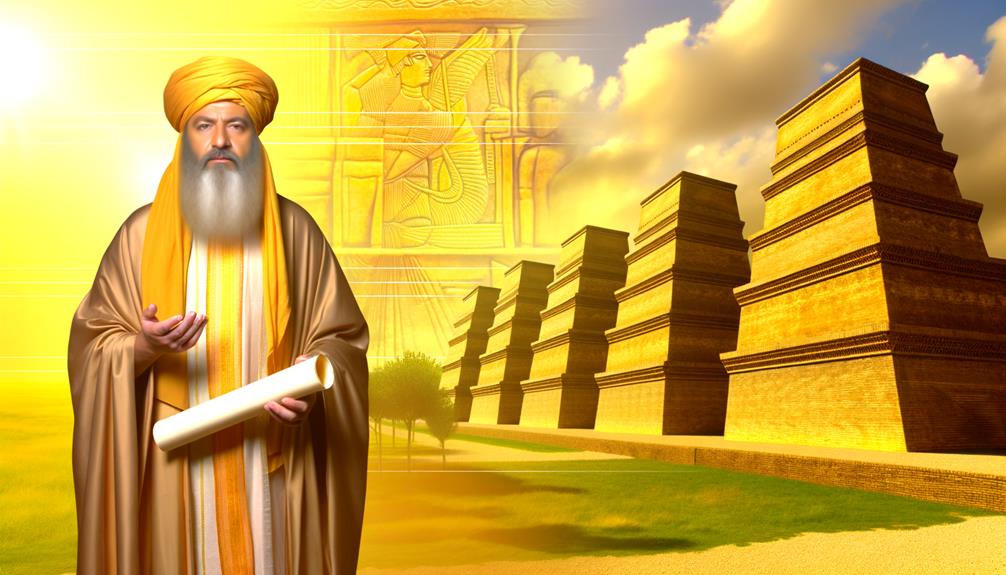
The name Belteshazzar, rooted in the Akkadian language, translates to 'Bel protect his life.' It emerges from the cultural and political context of the Babylonian Exile, where captives were renamed to signify assimilation and control. The name integrates religious and sociopolitical themes, with 'Bel' referencing the deity Marduk, underscoring Babylonian divine authority.
This renaming tradition reflects Babylonian strategies of integrating captives into their society, as seen with the Hebrew figure Daniel. Belteshazzar encapsulates the intersection of linguistic, cultural, and religious dimensions prevalent in ancient Mesopotamia.
Understanding this reveals deeper insights into Babylonian societal mechanisms.
Key Takeaways
- Belteshazzar means 'Bel protect his life' and is derived from Akkadian.
- 'Bel' in the name refers to the Babylonian deity Marduk.
- The name reflects Babylonian practices of assimilating captives through renaming.
- It signifies religious and cultural integration within the Babylonian Empire.
- The name highlights the socio-religious dynamics of ancient Mesopotamia.
Historical Context of Belteshazzar
Rooted in the narratives of the Babylonian Exile, the name Belteshazzar offers significant insight into the cultural and political milieu of ancient Mesopotamia. This period, marked by the forced relocation of the Israelites to Babylon, was a time of significant cultural interchange and political upheaval.
The Babylonian Empire, under rulers like Nebuchadnezzar II, sought to assimilate captive populations by integrating them into Babylonian society, often through the imposition of Babylonian names. Belteshazzar, attributed to the biblical figure Daniel, serves as a poignant example of this practice.
The renaming was not merely a superficial change but a strategic effort to embed captives within the Babylonian administrative and religious framework, reflecting the broader imperial policies of control and cultural integration.
Origins of the Name
The origins of the name Belteshazzar are intricately tied to the Babylonian historical context, reflecting the cultural and linguistic influences of the era.
Etymologically, the name is believed to be derived from the Akkadian language, potentially meaning 'Bel protect his life,' where 'Bel' refers to a major deity in the Babylonian pantheon.
Understanding these roots provides important insights into the socio-religious dynamics that influenced name-giving practices in ancient Mesopotamia.
What Should You Know About Babylonian Historical Context?
In ancient Babylonian society, names were imbued with significant cultural, religious, and political connotations, reflecting the intricate interplay between personal identity and the broader cosmological beliefs of the time.
The name Belteshazzar, assigned to the biblical figure Daniel, is a prime example of this tradition. Understanding the historical context in which this name originated involves examining several key aspects of Babylonian society:
- Religious Significance: Names often incorporated elements of the divine, honoring gods like Marduk.
- Political Implications: Names could reflect an individual's status or role within the empire.
- Cultural Integration: Foreign captives, like Daniel, were often renamed to assimilate them into Babylonian culture.
These elements underscore the multifaceted role of names in Babylonian history.
What Should You Know About Name Etymology?
Understanding the etymology of the name Belteshazzar illuminates the profound cultural and religious influences embedded within the Babylonian practice of renaming foreign individuals.
The name Belteshazzar is derived from the Akkadian 'Bēl-šu-uṣur,' translating to 'Bel, protect his life.' Here, 'Bel' refers to Marduk, the chief deity of Babylon, symbolizing divine guardianship and authority.
By assigning this name to Daniel, a Hebrew captive, the Babylonians not only integrated him into their socio-religious structure but also sought to assert their gods' supremacy over foreign deities.
This renaming practice reflects a broader strategy of cultural assimilation and control, revealing the intersection of language, power, and religion in ancient Mesopotamian society.
Linguistic Breakdown
Commencing with the linguistic breakdown of the name Belteshazzar, we first examine its etymological origins, tracing its roots to ancient Babylonian language structures.
This analysis requires contextualizing the name within its cultural and historical milieu to understand its semantic components.
What Should You Know About Etymological Origins Explored?
Derived from ancient Akkadian roots, the name Belteshazzar is a composite of elements that intricately reflect the linguistic and cultural milieu of Babylon. The name is believed to be derived from the Akkadian words 'Bel' (meaning 'lord' or 'master'), 'ṭeša' (likely translating to 'protect' or 'save'), and 'ʾuṣur' (meaning 'life' or 'soul'). This etymological breakdown reveals:
- Bel (Belu): Represents the Babylonian deity Marduk, often referred to as 'lord'.
- ṭeša: Suggests an invocation for protection or salvation.
- ʾuṣur: Implies the safeguarding of life or soul.
This intricate amalgamation underscores the profound religiosity and dependence on divine protection prevalent in Babylonian society.
What Should You Know About Cultural Context Analysis?
In the Babylonian cultural context, the name Belteshazzar not only reflects linguistic intricacies but also encapsulates the profound interplay between religion, identity, and societal values. The name, bestowed upon Daniel, a Jewish exile, signifies Babylonian attempts to assimilate and impose their pantheon upon captives. The following table elucidates the cultural dimensions embedded within the name:
| Aspect | Babylonian Culture | Analysis |
|---|---|---|
| Religion | Polytheistic | Reflects devotion to Marduk, the chief deity |
| Identity | Assimilative Practices | Renaming asserts control and integration |
| Societal Values | Hierarchical Structure | Names denote status and divine favor |
This renaming underscores Babylon's strategy of cultural dominance and the importance of names in conferring both religious allegiance and social hierarchy.
What Should You Know About Semantic Components Breakdown?
A thorough linguistic breakdown of the name Belteshazzar reveals a complex amalgamation of semantic components that reflect Babylonian religious and cultural elements. This name, attributed to Daniel in the biblical narrative, is a reflection of Babylonian linguistic intricacies.
Bel: This prefix is derived from 'Bel,' a title for the Babylonian god Marduk, signifying lordship and authority.
Connector: Acting as a conjunction, it serves to link the divine element to the subsequent parts of the name.
Shazzar: Likely from Akkadian 'šar-uzur,' meaning 'protect the king,' it conveys a plea for divine protection over royalty.
Each component interweaves religious reverence and sociopolitical themes, encapsulating the syncretic nature of Babylonian nomenclature.
Daniel's Babylonian Identity
Daniel's Babylonian identity is intricately tied to the name Belteshazzar, a designation bestowed upon him by the Babylonian court to signify his integration into their culture and administrative system. This renaming signifies the shift from his Hebrew origin to a role within Babylon's elite. The Babylonian court aimed to assimilate captives by embedding them into the fabric of their society through such symbolic acts.
| Hebrew Name | Meaning |
|---|---|
| Daniel | God is my judge |
| Babylonian Name | Meaning |
| Belteshazzar | Safeguard his life (by the deity) |
Thus, the name change from Daniel to Belteshazzar reflects not only a change in cultural identity but also a strategic effort by the Babylonians to align Daniel with their religious and administrative ethos.
Symbolism in Belteshazzar
The name Belteshazzar, imbued with profound religious and cultural symbolism, serves as a reflection of the Babylonian strategy of embedding their captives into the heart of their societal and theological framework. By renaming Daniel, the Babylonians sought to:
- Eradicate Previous Identity: By replacing Daniel's Hebrew name, which means 'God is my Judge,' with Belteshazzar, they aimed to sever his ties to his former cultural and religious identity.
- Impose Babylonian Deities: The name Belteshazzar is thought to invoke the protection of the Babylonian god Bel, thereby embedding Babylonian theological elements into Daniel's identity.
- Foster Assimilation: This renaming process facilitated the captives' assimilation into Babylonian society, ensuring that their loyalty and identity aligned with Babylonian imperial objectives.
This strategic renaming was a critical tool for Babylonian cultural hegemony.
Cultural Significance
Understanding the cultural significance of the name Belteshazzar necessitates examining the broader context of Babylonian practices and their impact on the identities of those they subjugated. The renaming process served to integrate captives into Babylonian society, signifying a shift in loyalty and identity.
Belteshazzar, which means 'Bel, protect the king,' highlights the prominence of the deity Bel (Marduk) in Babylonian religion and governance. This practice was not simply nominal but deeply symbolic, intended to transform captives' self-perception and allegiance.
Impact on Daniel's Story
By examining the influence of his Babylonian name, Belteshazzar, one gains deeper insight into how this imposition affected Daniel's personal journey and his steadfast adherence to his Hebrew faith amidst the pressures of Babylonian assimilation.
The name Belteshazzar, meaning 'Bel protect the king,' symbolized an attempt to integrate Daniel into Babylonian culture. This renaming had a multifaceted impact:
- Identity Conflict: Daniel had to navigate his Hebrew identity while bearing a name linked to Babylonian deities.
- Faith Resilience: Despite external pressures, Daniel's commitment to his faith remained unshaken, demonstrating unwavering spiritual resolve.
- Cultural Adaptation: Daniel's ability to excel in Babylonian society while maintaining his religious principles highlighted his adaptive yet steadfast nature.
Through this lens, Daniel's story exemplifies resilience.
Conclusion
To wrap up, the name Belteshazzar serves as a linguistic tapestry, intricately woven with historical, cultural, and symbolic threads that enrich the narrative of Daniel's Babylonian identity.
This name, embodying the complex interplay between Hebrew and Babylonian heritages, symbolizes the duality of existence in a foreign land.
Its multifaceted significance not only impacts Daniel's story but also offers a broader understanding of cultural assimilation and identity transformation in ancient Mesopotamian societies.