Meaning of the Name Aladdin
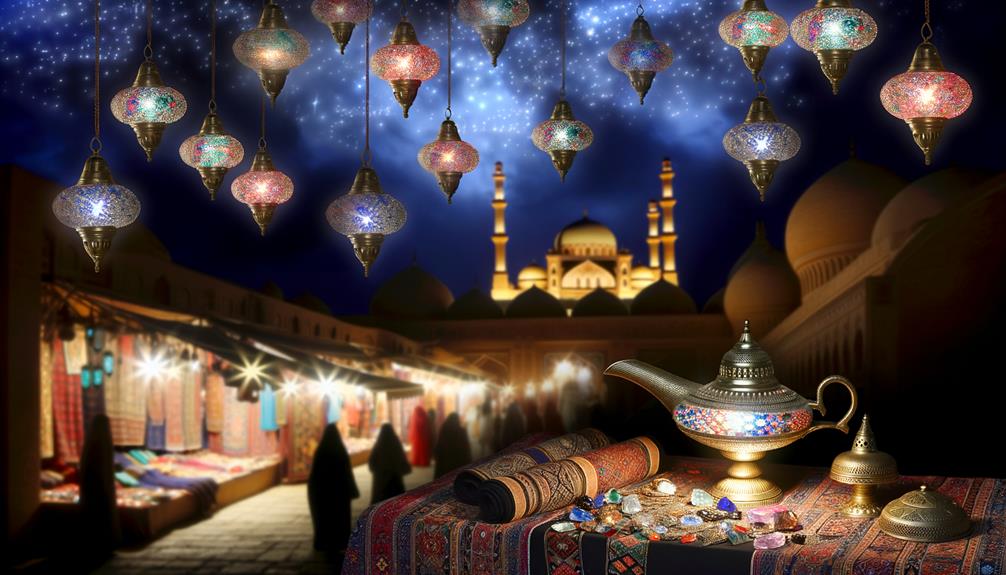
The name 'Aladdin' derives from the Arabic phrase 'Ala ad-Din,' meaning 'nobility of faith' or 'excellence of religion.' The prefix 'Ala' denotes elevation, while 'ad-Din' refers to faith, indicating a person of high spiritual or moral standing. Historically rooted in the tale "Aladdin and the Magic Lamp" from "One Thousand and One Nights," the name symbolizes themes of adventure, moral virtue, and socio-economic mobility.
It has had a lasting impact on global culture, representing not just wonder, but also the triumph of wit and moral integrity. For deeper insights into its cultural and historical context, explore further.
Key Takeaways
- The name Aladdin comes from the Arabic phrase 'Ala ad-Din,' meaning 'nobility of faith.'
- 'Ala' signifies elevation or height, while 'ad-Din' pertains to faith or religion.
- The name implies a person of elevated spiritual or moral standing.
- Aladdin is a character from 'One Thousand and One Nights,' symbolizing wonder and adventure.
- The story of Aladdin explores themes like rags-to-riches, moral lessons, and the triumph of wit.
Etymology of Aladdin
The name 'Aladdin' originates from the Arabic phrase 'Ala ad-Din,' which translates to 'nobility of faith' or 'excellence of religion.' This etymological root underscores a profound cultural and religious significance.
The prefix 'Ala' denotes elevation or height, while 'ad-Din' pertains to faith or religion, collectively implying a person of elevated spiritual or moral standing. This construction is typical in Arabic naming conventions, where names often embody aspirational qualities or virtues.
The phrase encapsulates a set of ideals, suggesting that the bearer of the name is expected to exhibit high moral and ethical standards. Understanding this etymology provides a deeper insight into the cultural context in which the name was historically used and appreciated.
Historical Significance
In examining the historical significance of the name Aladdin, it becomes apparent that its cultural resonance extends far beyond its linguistic roots. Originating from the Middle Eastern tale 'Aladdin and the Magic Lamp,' part of the 'One Thousand and One Nights' collection, the name has symbolized wonder and adventure for centuries.
Historically, the story of Aladdin has been adapted numerous times across various media, from early Arabic manuscripts to modern Western literature and cinema. Its enduring appeal lies in its universal themes of rags-to-riches transformation, the moral implications of desire, and the triumph of wit over adversity. These elements have secured Aladdin's lasting imprint on global cultural consciousness, illustrating the timeless nature of his narrative.
Cultural Context
How does the name Aladdin encapsulate diverse cultural connotations and societal values across different eras and regions?
The name Aladdin, rooted in Arabic, translates to 'nobility of faith' or 'nobility of religion,' reflecting a pervasive cultural emphasis on moral integrity and spiritual values.
Across various epochs, Aladdin has symbolized the interplay between socio-economic mobility and ethical virtue, particularly within Middle Eastern societies.
In Western contexts, the name often evokes images of magic and adventure, reflecting a fascination with the mystical Orient.
The character of Aladdin has also become a cultural bridge, fostering cross-cultural dialogue and understanding.
Therefore, the name Aladdin serves as a multi-faceted cultural symbol, embodying different societal values and ideals across time and geography.
Folklore and Tales
Embedded within the rich tapestry of folklore and tales, the story of Aladdin has transcended its original narrative to become a quintessential example of the universal human fascination with adventure, magic, and transformation.
Originating from the Middle Eastern collection 'One Thousand and One Nights,' the tale of Aladdin explores themes of destiny and ingenuity, encapsulated through Aladdin's journey from an impoverished youth to a figure of immense power.
The magical elements, such as the enchanted lamp and the genie, serve as metaphors for latent potential and the transformative power of self-discovery. The narrative structure invites readers to reflect on the complexities of fate, resourcefulness, and moral integrity, rendering it a timeless piece of the global storytelling tradition.
Modern Interpretations
Modern interpretations of the Aladdin story demonstrate a dynamic interplay between cultural preservation and contemporary adaptation, reflecting shifting societal values and technological advancements. These retellings often integrate modern themes while retaining core elements of the original narrative.
Key aspects include:
- Cinematic Adaptations: Films like Disney's 'Aladdin' reframe the tale for new generations, emphasizing themes of empowerment and diversity.
- Literary Reinterpretations: Modern authors reimagine Aladdin within various cultural and historical contexts, often addressing current social issues.
- Technological Innovations: Interactive media, including video games and virtual reality experiences, offer immersive retellings of Aladdin.
- Theatrical Performances: Stage adaptations incorporate contemporary music and choreography, blending tradition with modern entertainment.
These modern iterations illustrate the story's enduring relevance and adaptability.
Linguistic Variations
Exploring the name 'Aladdin' through its various linguistic forms reveals how language shapes and reflects the cultural identity and historical context of this enduring tale. Originating from the Arabic name 'Ala' ad-Din', meaning 'nobility of faith' or 'excellence of religion,' the name has been adapted into numerous languages, each reflecting unique phonetic and orthographic systems.
In French, it appears as 'Aladin,' while in Spanish, it is rendered 'Aladino.' These variations preserve the name's essence while adapting to linguistic norms. Additionally, transliterations in Asian languages, such as Japanese 'Araddin' (アラッディン), demonstrate the global reach of this narrative. Analyzing these adaptations underscores the interplay between linguistic evolution and cultural dissemination.
Aladdin in Popular Culture
Aladdin's presence in popular culture is pervasive, transcending generations through various adaptations in literature, film, theater, and digital media. The character's enduring appeal is evident in several key manifestations:
- Literature: The original 'One Thousand and One Nights' tale has inspired numerous books and scholarly analyses, preserving Aladdin's narrative across centuries.
- Film: Disney's animated classic (1992) and its live-action remake (2019) have cemented Aladdin's place in cinematic history, reaching global audiences.
- Theater: Broadway adaptations, such as the 2014 musical, showcase Aladdin's story through vibrant performances and intricate set designs.
- Digital Media: Video games and online streaming platforms have introduced Aladdin to new generations, ensuring his story remains relevant.
These adaptations highlight Aladdin's versatility and cultural significance.
Conclusion
The name Aladdin, rooted in rich etymology and historical significance, serves as a beacon in cultural and folkloric studies. Its journey from ancient tales to modern interpretations underscores its enduring appeal and adaptability.
Linguistic variations further highlight its global resonance. Like Scheherazade's tales, Aladdin's narrative continues to captivate, reflecting societal values and transformations.
This enduring legacy, enshrined in popular culture, underscores the timeless nature of Aladdin's story and its profound impact on collective imagination.