Biblical Meaning of the Name Jericho
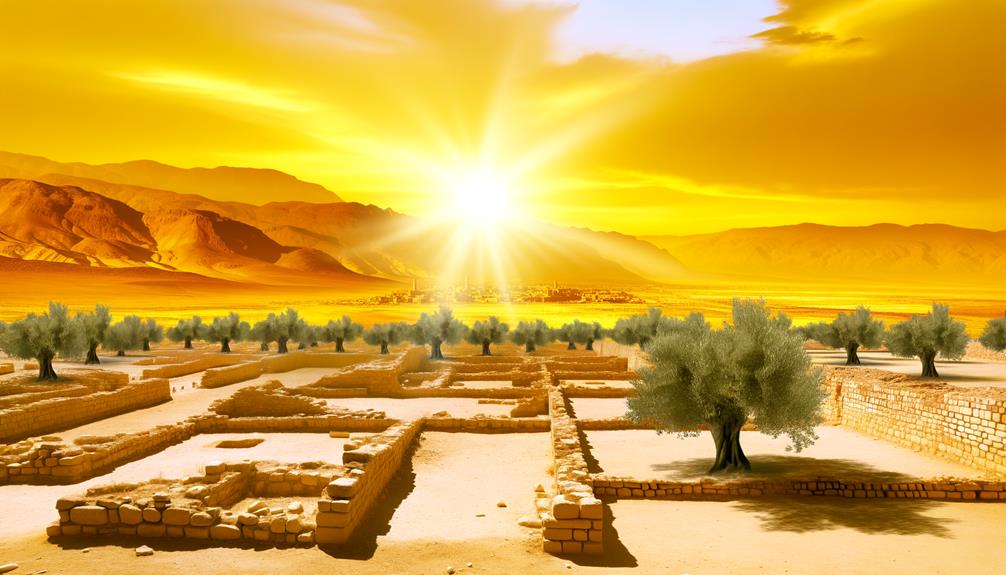
The name Jericho, derived from the Hebrew 'Yeriḥo', is intricately linked to the Canaanite word for 'moon' (Yareach), potentially indicating ancient lunar worship. Known as the 'City of Palms' (Deuteronomy 34:3), Jericho is historically significant as one of the oldest continuously inhabited cities.
Biblically, it is primarily noted for its miraculous conquest by Joshua, symbolizing divine intervention and the power of faith. This multifaceted city also offers rich spiritual lessons, showcasing the interplay between divine commands and human obedience.
To explore Jericho's deeper meanings and its archaeological findings, there is more to uncover.
Key Takeaways
- Jericho derives from the Hebrew 'Yeriḥo', linked to the Canaanite word for 'moon', symbolizing lunar worship.
- Known as the 'City of Palms', Jericho is a site of divine intervention and human faith in the Old Testament.
- The city's walls symbolize divine power and the necessity of unwavering faith in God's commands.
- Jericho's conquest by Joshua illustrates the importance of obedience and collective faith in divine intervention.
- Jericho's archaeological findings affirm its historical and biblical significance as one of the oldest inhabited cities.
Etymology of Jericho
The etymology of 'Jericho' reveals its ancient Semitic roots, with the name deriving from the Hebrew word 'Yeriḥo,' which is believed to be connected to the Canaanite word for 'moon' (Yareach).
This etymological link suggests that Jericho may have originally been associated with lunar worship or celestial events, reflecting the cultural and religious practices of its early inhabitants.
Archaeological evidence supports Jericho as one of the oldest continuously inhabited cities, further emphasizing its significance in ancient Near Eastern history.
The city's name, hence, encapsulates a blend of linguistic, cultural, and religious elements, providing a window into the spiritual and societal frameworks of the time.
Understanding this etymology enriches our comprehension of Jericho's historical and cultural legacy.
Jericho in the Old Testament
Jericho's etymological roots and ancient significance are vividly illustrated in its prominent role within the Old Scripture narrative. Known as the 'City of Palms' (Deuteronomy 34:3), Jericho is frequently depicted as a site of both divine intervention and human endeavor.
Its most notable mention occurs in the Book of Joshua, where the Israelites, led by Joshua, famously conquer the fortified city (Joshua 6:1-27). This event underscores Jericho as a symbol of faith and obedience to God's commands.
Additionally, Jericho is mentioned in the context of Elijah and Elisha's prophetic activities (2 Kings 2:4-5), which further cements its theological significance. Therefore, Jericho serves as a multifaceted reference within the biblical tradition.
Symbolism of the Walls
As a profound symbol within the biblical narrative, the walls of Jericho represent the intersection of divine power and human faith. According to the Book of Joshua, the collapse of these formidable walls was not a result of military prowess but of unwavering obedience to God's commands (Joshua 6:1-20).
The act of marching around the city for seven days, culminating in the priests' trumpets and the communal shout, underscores the necessity of faith in divine intervention. This event illustrates a theological principle: human efforts alone are insufficient without divine aid.
The walls' fall serves as a demonstration to the potency of collective faith and the miraculous power embedded within adherence to divine instruction, reinforcing the importance of spiritual commitment in achieving seemingly impossible feats.
Jericho's Role in Israelite History
Jericho holds a pivotal place in Israelite history, serving both as a symbol of divine intervention and military strategy. The ancient city's significance is underscored by its conquest under Joshua, which was marked by a unique and divinely orchestrated battle plan (Joshua 6:1-27).
This event not only demonstrated the Israelites' reliance on divine guidance but also established Jericho as a cornerstone in their journey to the Promised Land.
What Should You Know About Ancient City Significance?
Often regarded as one of the oldest inhabited cities in the world, the ancient city of Jericho played a pivotal role in Israelite history, particularly as the first major conquest under Joshua's leadership as recounted in the Book of Joshua.
Jericho's significance is multifaceted:
- Strategic Location: Positioned near the Jordan River, it served as a gateway to Canaan.
- Economic Hub: Its fertile lands made it an essential agricultural center.
- Cultural Crossroads: Influences from various civilizations intersected here.
- Religious Symbolism: Its walls represented divine intervention in Israelite victories.
Analytically, Jericho's prominence is underscored by its archaeological layers, revealing continuous occupation and reflecting its enduring importance in ancient Near Eastern history.
Contextually, this underscores why Jericho remains a focal point in biblical narratives.
What Should You Know About Conquest by Israelites?
The fall of Jericho, as narrated in the Book of Joshua, marks a cornerstone event in Israelite history, symbolizing the beginning of their conquest of Canaan under divine mandate. This event is pivotal, reflecting the Israelites' reliance on faith and obedience to divine instructions. Jericho's strategic location made it a significant military target, and its fall served as a psychological and tactical victory for the Israelites.
| Aspect | Details |
|---|---|
| Biblical Source | Book of Joshua, Chapter 6 |
| Historical Context | Late Bronze Age |
| Symbolic Meaning | Divine intervention and fulfillment of promises |
| Strategic Importance | Gateway to Canaan |
| Outcome | Total destruction and Israelite control |
This conquest is not merely historical but embeds theological significance, illustrating the unyielding faith of the Israelites.
What Should You Know About Joshua’s Divine Strategy?
How did Joshua's divine strategy underscore the pivotal role of Jericho in the broader narrative of Israelite history and their divinely sanctioned conquest of Canaan?
Joshua's approach, as ordained in the book of Joshua, Chapter 6, highlighted Jericho as the inaugural stronghold to be conquered, symbolizing the commencement of divine victory.
The methodical, faith-driven tactics employed included:
- Marching around the city: Demonstrating unwavering faith and obedience.
- The blowing of trumpets by priests: Signifying divine intervention.
- The collapse of Jericho's walls: Manifesting divine power over physical barriers.
- Total destruction of the city: Representing God's judgment and the fulfillment of His promise.
This strategic conquest established a template for subsequent victories and reinforced the Israelites' reliance on divine guidance (Joshua 6:1-27).
Spiritual Lessons From Jericho
Frequently explored in theological studies, the story of Jericho offers profound spiritual lessons that underscore faith, obedience, and divine intervention.
The fall of Jericho, described in Joshua 6, highlights the Israelites' unwavering faith in God's promises, as they adhered to seemingly illogical commands to march around the city. Their obedience resulted in a miraculous victory, illustrating that divine plans often transcend human understanding (Joshua 6:20).
This narrative also underscores the importance of relying on divine guidance rather than human strength. The spiritual lesson is clear: unwavering faith and obedience to God can lead to extraordinary outcomes.
This story continues to inspire believers, emphasizing that divine intervention is pivotal in overcoming formidable challenges.
Jericho in Modern Christianity
In contemporary Christian practice, Jericho's symbolic resonance extends into various aspects of worship and devotion. Its representation in worship songs often embodies themes of spiritual victory and divine intervention, while modern pilgrimages to Jericho offer faithful adherents a tangible connection to biblical history.
Additionally, Jericho serves as a focal point in Christian teachings, illustrating principles of faith and perseverance.
What Should You Know About Symbolism in Worship Songs?
Many contemporary worship songs incorporate the symbolism of Jericho, reflecting its biblical narrative of triumph and faith to inspire modern believers. The city's fall, chronicled in the Book of Joshua, serves as a powerful metaphor for overcoming obstacles through divine intervention. Worship songs often highlight:
- Walls falling down – Symbolizing breaking down barriers.
- Trumpet blasts – Representing the power of God's voice.
- Marching around the city – Embodying persistence in faith.
- Victory through faith – Illustrating spiritual triumph over adversity.
Such imagery resonates deeply within modern Christianity, reinforcing themes of perseverance and divine support.
What Should You Know About Modern Pilgrimages to Jericho?
Modern pilgrimages to Jericho provide contemporary Christians with a tangible connection to their faith's historical and spiritual roots, offering an opportunity for reflection and renewal. As one of the oldest cities in the world, Jericho holds immense significance in Biblical history, making it a focal point for spiritual journeys. Pilgrims visit various sites to deepen their understanding and appreciation of their faith.
| Destination | Significance | Activities |
|---|---|---|
| Mount of Temptation | Site of Jesus' temptation | Prayer, meditation |
| Zacchaeus' Sycamore Tree | Encounter of Jesus and Zacchaeus | Reflection, prayer |
| Tel es-Sultan | Ancient city remains | Historical tours |
| Elisha's Spring | Prophetic miracles | Spiritual renewal |
These pilgrimages provide a meaningful way to engage with the biblical narrative, enhancing personal faith and community bonds.
What Should You Know About Jericho in Christian Teachings?
As contemporary Christians undertake pilgrimages to Jericho, the city's multifaceted role in Christian teachings comes into sharper focus, illuminating its enduring theological significance. Jericho's presence in modern Christianity is both symbolic and instructive, providing lessons on faith, obedience, and redemption.
Key narratives from the Bible are often revisited to draw spiritual insights:
- Joshua's conquest of Jericho: Symbolizes God's deliverance and the power of faith.
- The story of Zacchaeus: Illustrates themes of repentance and divine grace.
- The healing of Bartimaeus: Highlights Jesus' compassion and miraculous power.
- The parable of the Good Samaritan: Offers a moral lesson about love and neighborliness.
These stories collectively serve as touchstones for contemporary Christian reflection and practice, reinforcing Jericho's timeless relevance.
Archaeological Insights
Recent archaeological excavations in the region of Jericho have revealed layers of historical significance, shedding light on the ancient city's intricate past and its biblical associations.
Scholars have unearthed evidence of successive settlements dating back to the Neolithic period, illustrating Jericho as one of the world's oldest continuously inhabited cities.
The discovery of massive fortification walls aligns with biblical narratives, particularly the account of Jericho's conquest in the Book of Joshua.
Carbon dating and stratigraphic analysis have provided critical insights into the city's chronological framework, correlating with periods mentioned in scripture.
These findings underscore Jericho's role as a critical juncture in Near Eastern history and bolster its historical and theological importance within biblical tradition.
Conclusion
The name Jericho, steeped in etymological roots and rich biblical narratives, ironically symbolizes both human fortification and divine intervention. While its historical walls epitomized strength, their ultimate collapse underscores the ephemeral nature of human constructs against divine will.
The city's multifaceted role in Israelite history, coupled with its enduring spiritual lessons, invites reflection on the paradox of human endeavor.
Modern archaeological findings further complicate simplistic interpretations, offering a nuanced understanding of Jericho's legacy in contemporary Christian thought.