Meaning of the Name Heinrich
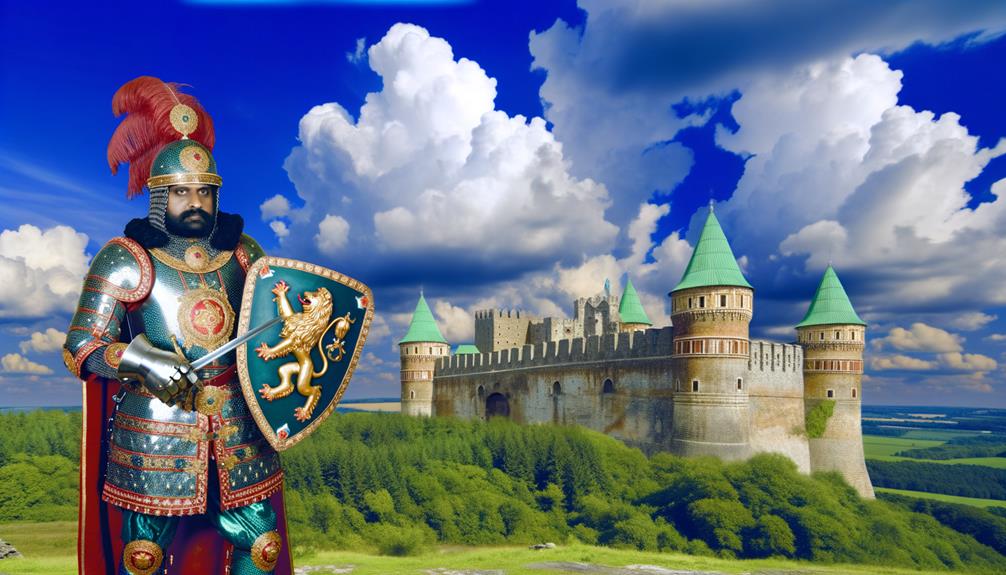
The name Heinrich derives from Old High German elements 'heim' (home/house) and 'rihhi' (ruler/king), symbolizing leadership and governance. This name reflects early Germanic socio-political structures and implies authority within one's domain.
Historically, it has been borne by notables like Heinrich Heine, Heinrich Hertz, and various monarchs, contributing significantly to European cultural and political landscapes. The name remains emblematic of stability and intellectual heritage.
Modern usage varies, with strongholds in regions of Germanic heritage, while its English, French, Italian, and Spanish variations showcase linguistic adaptability. For further insights, explore the historical and cultural nuances surrounding Heinrich.
Key Takeaways
- Heinrich means 'home ruler' or 'king' derived from Old High German elements 'heim' and 'rihhi'.
- The name symbolizes leadership, authority, and governance within one's domain.
- Heinrich reflects socio-political structures of early Germanic societies.
- Historically linked to European emperors and influential figures in literature, science, and history.
- Popular variations include Henry (English), Henri (French), Enrico (Italian), and Enrique (Spanish).
Etymology of Heinrich
The name Heinrich derives from the Old High German elements 'heim,' meaning 'home' or 'house,' and 'rihhi,' meaning 'ruler' or 'king.' This etymology suggests a connotation of leadership and authority within one's domain, reflecting the socio-political structures of early Germanic societies where governance was often intertwined with familial and territorial control.
The combination of these elements underscores a name that conveys stability, protection, and governance. Over time, Heinrich evolved through various linguistic transformations, maintaining its core meaning while adapting to different cultural contexts. The name's endurance attests to its potent symbolism, encapsulating the ideal of a ruler who is both a guardian of home and a sovereign figure.
This rich etymological heritage contributes significantly to its lasting appeal.
Historical Figures Named Heinrich
Throughout history, numerous influential figures named Heinrich have epitomized the leadership and authority embedded in the name's etymology.
Heinrich Heine, a distinguished 19th-century poet, is celebrated for his literary contributions that shaped German Romanticism.
Heinrich Hertz, a pioneering physicist, made groundbreaking advancements in electromagnetic theory, laying the groundwork for modern telecommunications.
Similarly, Heinrich Schliemann, an archaeologist, unearthed the ancient city of Troy, revolutionizing the field of archaeology.
Each of these individuals demonstrated exceptional prowess and leadership in their respective disciplines, reinforcing the powerful connotations associated with the name Heinrich.
Their enduring legacies continue to influence contemporary thought in literature, science, and history, underscoring the profound impact of their contributions.
Heinrich in Royalty
The name Heinrich has been borne by several notable figures in European royalty, including emperors and kings who left significant imprints on their respective domains.
Heinrich's influence is particularly evident within the Holy Roman Empire, where the name was associated with dynastic continuity and political stability.
Examining these historical figures provides insight into how the name Heinrich contributed to the shaping of royal legacies.
Notable Historical Figures
Among the most prominent figures named Heinrich in royalty, one finds a rich tapestry of influential leaders who have shaped the course of European history. Heinrich I, also known as Henry the Fowler, was the first German king of the Saxon dynasty, reigning from 919 to 936. His consolidation of German territories laid the groundwork for the Holy Roman Empire.
Another notable figure is Heinrich IV, whose reign experienced the Investiture Controversy, a significant conflict between church and state. Heinrich VI continued this legacy by expanding imperial influence through strategic marriages and military campaigns. These rulers named Heinrich exemplify the name's historical weight, reflecting periods of political consolidation, conflict, and expansion within European power structures.
Heinrich Dynastic Influence
Examining the dynastic influence of Heinrichs in European royalty reveals a legacy marked by political strategy, territorial expansion, and pivotal historical events. The House of Hohenstaufen, for instance, produced several emperors named Heinrich who profoundly shaped medieval Europe.
Heinrich I, also known as Henry the Fowler, was instrumental in founding the Ottonian dynasty and consolidating German territories. Heinrich VI's reign saw notable developments in the Holy Roman Empire.
The impact of these rulers can be summarized through:
- Establishing and consolidating major dynasties like the Ottonian and Hohenstaufen
- Expanding territories through military conquests and strategic marriages
- Influencing the political landscape of medieval Europe
- Enacting key reforms that shaped the governance of their domains
Their legacies continue to inform our understanding of medieval European history.
Cultural Impact of Heinrich
Heinrich, as a name, has played a significant role in shaping cultural and historical narratives across various European societies. From medieval monarchs to influential thinkers, the name Heinrich has been synonymous with leadership, intellectual prowess, and cultural heritage. Its impact can be observed in numerous fields, including politics, science, and the arts. Below is a table highlighting key individuals named Heinrich and their contributions:
| Name | Contribution |
|---|---|
| Heinrich I | First King of Germany |
| Heinrich Heine | Renowned German poet and essayist |
| Heinrich Hertz | Physicist who discovered electromagnetic waves |
| Heinrich Schütz | Composer pivotal to early German Baroque |
| Heinrich Himmler | Leading member of Nazi Germany |
This table underscores the diverse and profound influence of the name Heinrich in European history.
Heinrich in Literature
The name Heinrich has been prominently featured in literature, often associated with historical literary figures such as Heinrich Heine and Heinrich Böll.
These authors have not only shaped literary traditions but have also imbued the name with rich symbolism and themes, ranging from romanticism to post-war realism.
The recurrence of the name in various narrative contexts underscores its cultural resonance and thematic depth.
Historical Literary Figures
Numerous notable literary figures have borne the name Heinrich, each contributing uniquely to the cultural and intellectual heritage of their respective eras.
Among these, several stand out for their seminal works and lasting influence:
- Heinrich Heine: A German poet known for his lyrical poetry and incisive prose, influencing modern German literature and political thought.
- Heinrich von Kleist: A playwright and novelist whose works explored the complexities of human psychology and societal norms.
- Heinrich Böll: A Nobel Prize-winning author whose post-war novels and short stories provide critical insights into German society.
- Heinrich Mann: An influential novelist and essayist, known for his critiques of authoritarianism and exploration of democratic ideals.
These figures exemplify the diverse impact of Heinrichs in literature.
Symbolism and Themes
Exploring the symbolism and recurring themes associated with characters named Heinrich in literature reveals nuanced insights into identity, power dynamics, and existential struggles. Often depicted as figures grappling with authority and self-definition, Heinrichs serve as conduits for examining societal and personal conflicts.
This name frequently appears in works that dig into the tension between individual aspirations and communal expectations. Heinrichs are also emblematic of the quest for meaning in a seemingly indifferent universe, reflecting existential themes of alienation and the search for purpose. The literary Heinrich often embodies the paradox of strength and vulnerability, illustrating the complex interplay between external influence and internal resolve.
Through these characters, authors investigate the multifaceted nature of the human condition.
Modern Usage of Heinrich
In contemporary contexts, the name Heinrich maintains a presence primarily within German-speaking communities and among individuals with heritage linked to Germanic cultures. This name continues to be used in various modern settings, reflecting its historical and cultural significance.
Heinrich is often associated with academic and professional circles. Many scholars and professionals carry this name, lending it an air of intellectual prestige.
In literary and artistic domains, the name appears in literature and arts, often evoking classic Germanic themes.
For families with deep cultural roots, Heinrich may be chosen to honor their heritage and tradition.
Public figures from politics, science, and entertainment also bear the name Heinrich, adding to its contemporary resonance.
This enduring relevance underscores Heinrich's multifaceted role in modern society.
Popularity Trends
How has the popularity of the name Heinrich evolved over recent decades across different regions and demographics?
In Germany, Heinrich remains a traditional name, though its popularity has declined, giving way to more contemporary choices.
In contrast, regions with strong Germanic heritage, such as Austria and Switzerland, still see moderate use, particularly among older generations.
In the United States, Heinrich is relatively rare, often associated with cultural or familial significance rather than common usage.
Scandinavian countries exhibit a similar trend, where Heinrich is less prevalent but occasionally chosen for its classic appeal.
Heinrich in Different Languages
Although the name Heinrich is rooted in Germanic origins, its variations and adaptations across different languages reveal a rich tapestry of cultural influences and linguistic transformations.
In English, the name is commonly rendered as Henry, maintaining a phonetic relation while adapting to linguistic norms.
The French version, Henri, reflects both pronunciation and orthographic preferences unique to the French language.
In Italian, the name becomes Enrico, showcasing a Latin influence.
Spanish-speakers often use Enrique, further emphasizing the Romance language evolution.
These variations not only highlight the name's adaptability but also underscore its enduring popularity across diverse linguistic landscapes, illustrating the interconnectedness of European cultures through shared nomenclature.
Conclusion
The name Heinrich, rooted in ancient etymology and borne by historical figures, royalty, and literary characters, embodies a tapestry of cultural and historical significance. Its resonance across languages and eras underscores its enduring legacy.
The modern usage and fluctuating popularity of Heinrich reflect societal changes while maintaining a timeless essence. Like a well-worn coin, Heinrich's multifaceted history and cultural impact continue to shine, symbolizing a rich heritage that bridges past and present.