Meaning of the Name Holland
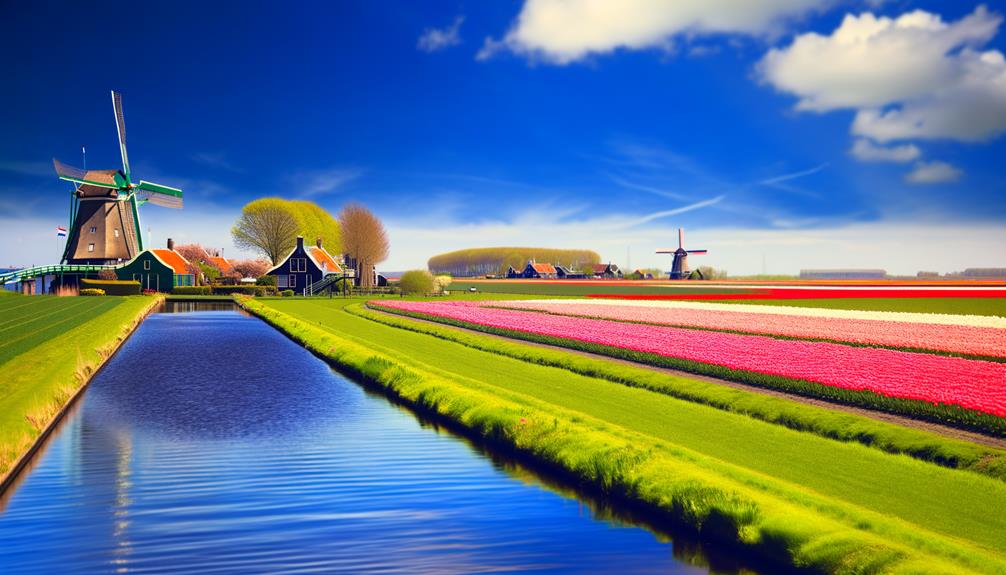
The name 'Holland' originates from a historically significant region within the Netherlands. Linguistically, it derives from the Old Dutch 'Holtland' and Old English 'hol' and 'land', meaning 'wooded land' or 'hollow land'.
This area includes North and South Holland, famed for its flat landscapes, canals, and rich coastal lines. Over centuries, Holland evolved as a hub of trade and agricultural prosperity.
Culturally, it is iconic for windmills, tulips, and pioneering water management. Its historical landscape and cultural heritage reflect a unique blend of natural beauty and engineering marvel, hinting at a deeper legacy of Dutch development and influence.
Key Takeaways
- The name 'Holland' originates from Old Dutch 'Holtland,' meaning 'wooded land.'
- Holland historically refers to a significant region in the Netherlands, encompassing North and South Holland.
- The name reflects the region's past dense forests and fertile soil.
- Holland is symbolically associated with windmills, tulips, and canals, reflecting Dutch cultural heritage.
- The term evolved through historical and geographical changes, representing the Dutch maritime trade history.
Geographical Significance
The name 'Holland' originates from a historical region in the western part of the Netherlands, which played a pivotal role in the country's geographical and political development.
Geographically, Holland encompasses two provinces: North Holland and South Holland. These areas are characterized by their flat landscapes, extensive canal systems, and significant coastal lines along the North Sea. The region's fertile soil and strategic maritime location facilitated early trade and agricultural prosperity.
Additionally, Holland's intricate network of waterways not only enabled efficient transportation but also contributed to the region's economic and cultural prominence. This geographical significance has had lasting impacts, making Holland a central hub in the Netherlands' historical and contemporary identity.
Historical Origins
The historical origins of the name 'Holland' are deeply rooted in early Dutch influence, reflecting significant cultural and political developments in the region.
Linguistically, the term is derived from the Old Dutch 'Holtland,' which translates to 'wooded land,' emphasizing the area's initial geographical characteristics.
This etymological insight reveals not only the physical landscape but also the sociopolitical milieu that shaped the identity of what is now a prominent part of the Netherlands.
Early Dutch Influence
Early Dutch influence on the name 'Holland' can be traced back to the medieval period when the region was a significant political and cultural entity within the Holy Roman Empire. During this era, Holland emerged as a prominent county, with its strategic location fostering trade and maritime prowess.
The Counts of Holland played pivotal roles in regional politics, bolstering the area's status and contributing to its cultural heritage. Significant urban centers like Amsterdam and Rotterdam flourished, becoming hubs of economic activity and intellectual exchange.
The Dutch influence extended to governance, legal frameworks, and societal structures, embedding the name 'Holland' deeply into European consciousness. This historical prominence laid the groundwork for the enduring legacy and identity associated with Holland today.
Etymological Roots Explained
Tracing its origins to Old Dutch, the name 'Holland' derives from the words 'holt' meaning 'wood' or 'forest' and 'land' signifying 'territory,' reflecting the region's early landscape characteristics. This etymological formation underscores the significance of natural resources in the region's historical identity.
Understanding the linguistic roots of 'Holland' offers a window into the cultural and environmental context of the early Dutch people. Below, the table elucidates key aspects of the term:
| Term | Old Dutch Origin | Meaning |
|---|---|---|
| Holland | Holt + Land | Wooded Territory |
| Holt | Holt | Wood/Forest |
| Land | Land | Territory |
| Early Use | Medieval Period | Regional Identity |
| Modern Use | Present Day | Netherlands Area |
This analysis aids in appreciating how historical linguistics shapes regional nomenclature.
Etymology
The etymology of the name Holland traces back to Old English, originating from the words 'hol' and 'land,' meaning 'wooded land.'
Over time, the name evolved, reflecting shifts in linguistic practices and societal changes.
Geographically, Holland's designation underscores its historical landscape, characterized by forests and low-lying terrain, which has notably influenced its cultural and regional identity.
Old English Origins
Rooted in Old English, the name Holland originates from the words 'hol' meaning 'hollow' and 'land' meaning 'land,' symbolizing a low-lying region. This etymological construction reflects the geographical nature of the areas typically associated with the name, such as marshlands and valleys.
Understanding the Old English origins provides insight into both linguistic and cultural aspects of early English settlements.
Here are key points illustrating its Old English origins:
- 'Hol' (Hollow): Indicates low-lying, often waterlogged terrain.
- 'Land' (Land): Refers to the physical territory.
- Geographical Significance: Names often described physical characteristics of the land.
- Cultural Insight: Early English names were pragmatic, reflecting everyday surroundings and topography.
Name Evolution Over Time
Over the centuries, the name Holland has undergone significant transformations, influenced by linguistic shifts, cultural exchanges, and historical developments.
Originating from the Old English term 'Holland,' meaning 'wooded land,' the name evolved as it traversed various periods and regions. In the Middle Ages, the Dutch term 'Holtland' (meaning 'woodland') became prevalent, reflecting the region's dense forests. This term was gradually anglicized to 'Holland' by English speakers.
The linguistic evolution continued as the name was adopted by other cultures, each imposing their phonetic nuances. Historical documents and trade interactions further cemented its usage in different forms. Through these changes, Holland has come to be recognized globally, preserving both its ancient roots and its journey through time.
Geographical Significance
In examining the geographical significance of the name 'Holland,' one must consider its etymological roots in the Old English and Dutch terms for 'wooded land' and 'woodland,' respectively. This nomenclature reflects the region's historical landscape, dominated by dense forests and fertile grounds.
Understanding the geographical implications requires delving into:
- Historical Land Use: Early settlements utilized the rich, forested terrain for agriculture and habitation.
- Topographical Features: The low-lying, marshy areas were gradually transformed through human intervention.
- Economic Development: Timber from woodlands played an essential role in shipbuilding and trade.
- Cultural Identity: The term 'Holland' symbolizes a connection to nature and the utilization of natural resources.
This analysis provides a thorough understanding of how geography influenced the naming and development of Holland.
Cultural Connotations
The name 'Holland' evokes a rich tapestry of cultural connotations, intertwined with historical significance and linguistic evolution. Beyond its geographical identity, Holland has become synonymous with various cultural elements that reflect the region's heritage. It is often associated with iconic symbols like windmills, tulips, and canals, which have come to represent Dutch innovation and aesthetic beauty. Moreover, Holland carries connotations of maritime prowess and trade, harking back to the Golden Age when it was a hub of global commerce. In contemporary usage, Holland also suggests a progressive society known for its contributions to art, science, and human rights.
| Symbol | Cultural Connotation | Historical Context |
|---|---|---|
| Windmills | Innovation | Industrial advancements |
| Tulips | Aesthetic beauty | Tulip mania of the 1630s |
| Canals | Engineering marvels | 17th-century infrastructure |
| Maritime trade | Global commerce | Dutch Golden Age |
Linguistic Roots
Tracing its etymology reveals that 'Holland' originates from the Old Dutch words 'holt' (meaning wood) and 'land' (meaning land), signifying a wooded region. This linguistic origin underscores the historical landscape of the area, which was once heavily forested. Understanding the term's roots involves examining various linguistic and historical elements:
- Old Dutch Influence: The term 'holt' and 'land' reflect the Germanic linguistic family, particularly the Old Dutch language.
- Geographical Context: The name indicates a region characterized by dense forests, prevalent in the early medieval period.
- Historical Usage: The terms evolved, reflecting changes in the region's topography and settlement patterns.
- Cultural Legacy: The name 'Holland' continues to evoke the natural and cultural heritage of the Netherlands.
Global Influence
Expanding beyond its etymological roots, the name 'Holland' has garnered significant global recognition, symbolizing not just a region in the Netherlands but also its far-reaching cultural and economic impact. Historically, Holland's maritime prowess established it as a global trade hub. Today, 'Holland' signifies innovation in sectors like water management, sustainable energy, and design.
| Aspect | Global Influence |
|---|---|
| Cultural Heritage | Renowned for art, tulips, and windmills |
| Economic Powerhouse | Key player in global trade and logistics |
| Innovation | Leaders in technology and sustainability |
Such multifaceted influence underscores Holland's enduring legacy. The name encapsulates centuries of historical significance and modern advancements, making it synonymous with progress and cultural richness. This global footprint continues to shape perceptions and foster international collaborations.
Conclusion
The name 'Holland' encapsulates a rich tapestry of geographical significance, historical origins, and etymological depth. Deriving from the Old Dutch 'Holt land,' meaning 'wooded land,' it reflects both the physical landscape and the cultural evolution of the region.
Notably, 'Holland' is used colloquially to refer to the entire Netherlands, despite officially representing only two of its twelve provinces. This linguistic and cultural nuance underscores the global influence and enduring legacy of the name.