Meaning of the Name Cleopatra
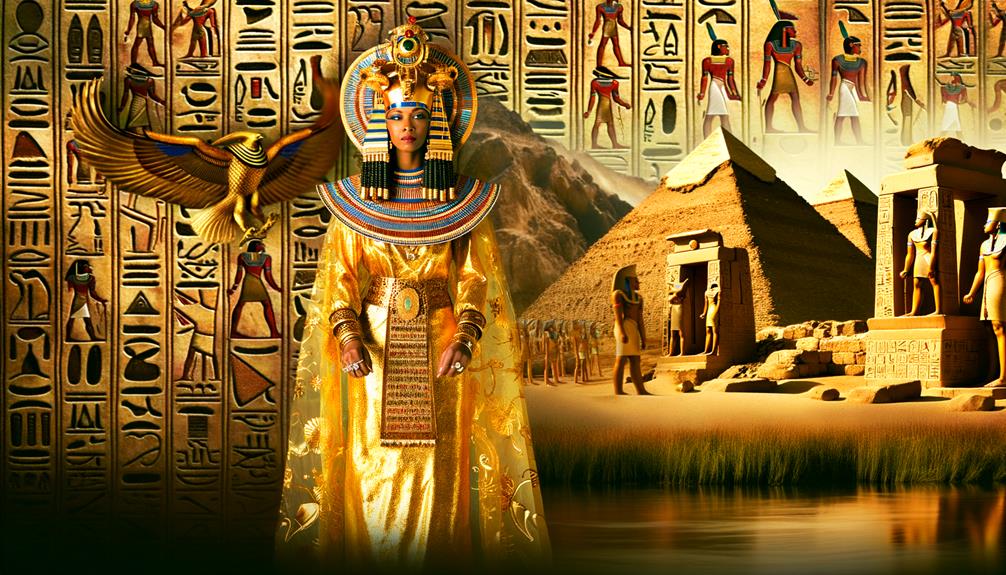
The name Cleopatra is derived from the Greek words 'kleos' and 'patēr', meaning 'glory of the father'. It signifies familial honor and was prominently prevalent in the Ptolemaic dynasty of Egypt, emphasizing the integration of Greek and Egyptian cultures during the Hellenistic period.
This name reflects the societal prestige of the ruling elite and is immortalized by historical figures, most famously Cleopatra VII. The name has since carried cultural weight and historical significance, influencing literature, arts, and modern interpretations.
Explore further to understand the profound impact of Cleopatra on historical narratives and cultural legacies.
Key Takeaways
- Cleopatra means 'glory of the father,' derived from Greek words 'kleos' (glory) and 'patēr' (father).
- The name signifies familial honor and societal prestige in Hellenistic Egypt.
- Commonly used in the Ptolemaic dynasty, reflecting royal heritage.
- Represents the cultural integration of Greek and Egyptian practices.
- The name Cleopatra carries historical and cultural weight, symbolizing political acumen and complex identity.
Etymology of Cleopatra
The name Cleopatra originates from the Greek words 'kleos,' meaning 'glory,' and 'patēr,' meaning 'father,' thereby translating to 'glory of the father.'
This etymological analysis suggests a name designed to convey honor and lineage, particularly highlighting paternal pride. Cleopatra was a common name in the Ptolemaic dynasty of Egypt, linking linguistic heritage to the Greek origins of this ruling family.
The name's construction underscores the cultural significance of lineage and reputation in Hellenistic society. It was not merely a personal identifier but a statement of familial prestige.
This context aids in understanding why the name Cleopatra was recurrently used, as it encapsulated both the values and aspirations of the ruling elite in Hellenistic Egypt.
Historical Context
In understanding the historical context of the name Cleopatra, it is essential to take into account the socio-political landscape of Hellenistic Egypt and its integration of Greek and Egyptian cultures. Following Alexander the Great's conquest, the Ptolemaic dynasty ruled Egypt, blending Greek administrative practices with traditional Egyptian customs. The name Cleopatra became prominent during this period due to several queens who bore the name.
Cultural Integration: Greek rulers adopted Egyptian traditions, deities, and language to legitimize their reign.
Political Landscape: The Ptolemies maintained a complex relationship with Rome, balancing diplomacy and conflict.
Dynastic Significance: The name Cleopatra was a dynastic title, signifying royal heritage and continuity within the Ptolemaic lineage.
This amalgamation of cultures profoundly influenced the historical significance of the name Cleopatra.
Greek Origins
Cleopatra, a name of Greek origin, derives from the words 'kleos' meaning glory and 'pater' meaning father, signifying 'glory of the father.' This etymology is rooted in the ancient Greek language, reflecting the cultural and linguistic influences of the Hellenistic period. The name itself embodies a confluence of familial honor and societal prestige, often attributed to individuals of high status.
| Greek Term | Meaning |
|---|---|
| Kleos | Glory |
| Pater | Father |
| Cleopatra | Glory of the Father |
| Hellenistic Period | Era of Greek cultural influence |
The adoption of Greek names, such as Cleopatra, underscores the prevalence of Greek culture in various regions, including Egypt. This linguistic adoption indicates a broader pattern of cultural integration and influence during the era.
Cultural Significance
Cleopatra's name carries significant cultural weight, stemming from her influential role in Egyptian history and her extensive representation in literature and the arts.
Her legacy has permeated modern pop culture, evident in numerous films, books, and artistic interpretations.
This broad cultural impact underscores the enduring fascination with Cleopatra as a historical and mythological figure.
Egyptian Historical Impact
The cultural significance of Cleopatra in Egyptian history is underscored by her enduring legacy as a symbol of political acumen and complex identity. Cleopatra VII, the last active ruler of the Ptolemaic Kingdom of Egypt, effectively navigated Rome's political landscape to maintain her nation's sovereignty. Her reign marked a pivotal era of cultural amalgamation, blending Egyptian and Hellenistic traditions.
Cleopatra's strategic alliances with Julius Caesar and Mark Antony were instrumental in her political maneuvers.
Her representation on coinage and monuments emphasized her role as both a pharaoh and a divine figure.
The Battle of Actium in 31 BCE, leading to her defeat, signified the end of Egyptian pharaonic rule and the beginning of Roman dominion.
This multifaceted impact illustrates Cleopatra's significant role in shaping Egyptian history.
Literature and Arts Influence
Countless works of literature and art have immortalized Cleopatra VII, reflecting her profound influence on cultural narratives throughout history. William Shakespeare's tragedy 'Antony and Cleopatra' epitomizes her dramatic allure and political acumen, intertwining love and power.
In visual arts, painters like Jean-Léon Gérôme and Lawrence Alma-Tadema rendered her enigmatic presence through opulent canvases, emphasizing her role as a symbol of beauty and intelligence.
Plutarch's 'Life of Antony' offers a historical account that has inspired numerous adaptations, solidifying Cleopatra's legacy in Western canon. These portrayals collectively shape the perception of Cleopatra as a complex figure, balancing her political influence with her storied personal life, thereby enhancing her enduring significance in cultural history.
Modern Pop Culture
In contemporary pop culture, Cleopatra's legacy continues to thrive, manifesting in various media forms such as film, television, and fashion, which perpetuate her image as an epitome of power, beauty, and intrigue. Her portrayal in these media often underscores her historical significance and enduring allure.
Evidence of her cultural impact includes:
- Film and Television: Iconic portrayals by actresses such as Elizabeth Taylor in the 1963 film 'Cleopatra' have cemented her image in popular imagination.
- Fashion: Designers frequently draw inspiration from Cleopatra's distinctive style, integrating elements like elaborate headdresses and bold makeup into modern fashion.
- Music: Artists across genres reference Cleopatra to evoke themes of regality and allure, illustrating her continued relevance.
This multifaceted representation underscores Cleopatra's enduring mythos in modern culture.
Cleopatra in Literature
Numerous literary works across various cultures and time periods have depicted Cleopatra, each adding layers to her multifaceted persona. In antiquity, Roman writers like Plutarch and Dio Cassius presented her as a cunning and politically adept figure.
Shakespeare's 'Antony and Cleopatra' immortalized her in the English literary canon, emphasizing her romantic and tragic dimensions. French playwright Jean Racine's 'Cleopatra' and George Bernard Shaw's 'Caesar and Cleopatra' further illustrate her adaptability within diverse narrative frameworks.
Each portrayal reflects the prevailing cultural and socio-political attitudes of the time, illustrating how Cleopatra's legacy has been continually reinterpreted. These literary depictions contribute significantly to our understanding of her complex identity beyond her historical reign.
Modern Perception
In contemporary times, the name Cleopatra has been greatly shaped by media and pop culture, often emphasizing her allure and political acumen.
Historical reinterpretations also play a pivotal role, with new scholarship frequently revisiting her legacy through various lenses.
These modern perceptions contribute to an intricate and evolving understanding of Cleopatra's importance in both historical and cultural contexts.
Media and Pop Culture
Cleopatra's name has become synonymous with timeless beauty and political intrigue, permeating various facets of modern media and pop culture. Her persona has been immortalized in numerous forms of entertainment, reflecting both historical fascination and artistic interpretation.
- Film and Television: Cleopatra's life has been dramatized in films such as the 1963 classic starring Elizabeth Taylor, and in various television series, illustrating her enduring appeal.
- Literature: Countless novels and scholarly works have been dedicated to exploring her complex character and reign, blending historical facts with imaginative storytelling.
- Fashion and Beauty: Cleopatra's iconic style continues to inspire modern fashion designers and beauty brands, with many collections and products bearing her name and image.
These representations underscore Cleopatra's lasting influence and allure in contemporary culture.
Historical Reinterpretations
Modern perceptions of Cleopatra are shaped not only by her portrayal in media and pop culture but also by ongoing historical reinterpretations that seek to provide a more nuanced understanding of her life and legacy. Scholars now emphasize her political acumen, linguistic skills, and strategic alliances, challenging older narratives that focused primarily on her romantic liaisons. These reinterpretations highlight her role as a formidable leader who sought to preserve Egypt's independence amid Roman expansion.
| Aspect | Traditional View | Modern Interpretation |
|---|---|---|
| Political Acumen | Overlooked | Emphasized |
| Linguistic Skills | Understated | Highlighted |
| Strategic Alliances | Romanticized | Politically Motivated |
| Leadership Role | Diminished | Central |
| Cultural Impact | Exoticized | Contextualized |
This evolving understanding allows for a richer and more complex portrayal of Cleopatra.
Famous Namesakes
Among the various notable individuals bearing the name Cleopatra, the most renowned is Cleopatra VII, the last active ruler of the Ptolemaic Kingdom of Egypt. Her political acumen and alliances with Roman leaders Julius Caesar and Mark Antony have made her a central figure in both historical and popular narratives.
However, Cleopatra VII is not the only famous bearer of this distinguished name.
- Cleopatra Thea: A queen of the Seleucid Empire, who ruled during the Hellenistic period and played a significant role in the political intrigues of her time.
- Cleopatra Selene II: Daughter of Cleopatra VII and Mark Antony, she became Queen of Mauretania alongside her husband, King Juba II.
- Cleopatra Eurydice: A Macedonian princess, she was married to King Philip II of Macedon, the father of Alexander the Great.
This list underscores the historical significance and enduring legacy of the name Cleopatra across different eras and regions.
Legacy and Influence
The legacy of the name Cleopatra extends beyond historical records, influencing art, literature, and popular culture for centuries. Cleopatra VII, the most renowned bearer of the name, has been immortalized in works by Shakespeare, such as 'Antony and Cleopatra,' and in modern adaptations like the 1963 film starring Elizabeth Taylor. Her image as a powerful and enigmatic ruler has inspired countless artists and authors.
The name symbolizes intelligence, political acumen, and romantic intrigue, contributing to its enduring appeal. Scholarly research highlights Cleopatra's strategic alliances and cultural impact, further cementing her status in academic studies. Therefore, Cleopatra's name remains a potent symbol in various domains, reflecting her lasting influence on global cultural and intellectual history.
Conclusion
The name Cleopatra, originating from Greek roots and imbued with cultural significance, juxtaposes its ancient etymological origins with its enduring legacy in literature and modern perception.
While historical contexts and famous namesakes highlight its illustrious past, contemporary interpretations and cultural references underscore its timeless resonance.
This synthesis of ancient heritage and modern relevance encapsulates the multifaceted legacy of Cleopatra, illustrating how a name can traverse centuries, embodying both historical grandeur and ongoing cultural influence.