Meaning of the Name Zari
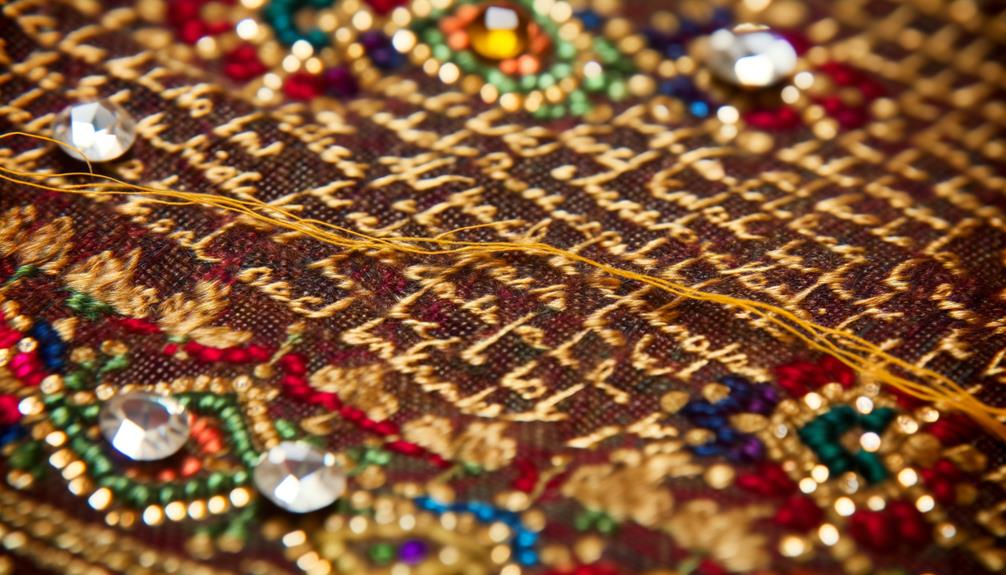
The name 'Zari' has its roots in Persian and Arabic, where 'zar' translates to 'gold' in Persian, and the suffix 'i' personalizes the term. It evokes concepts of beauty, value, and elegance, reflecting cultural values through its phonetic simplicity and cross-cultural appeal.
Historically, 'Zari' refers to gold or silver thread used in textile weaving, symbolizing opulence in Persian and Mughal empires. The name has transcended cultures, seen in traditional Indian garments and intricate Turkish embroidery.
'Zari' embodies wealth, refinement, and artistic excellence, resonating with deep historical and symbolic meanings. This rich tapestry of significance beckons further exploration.
Key Takeaways
- Zari originates from Persian and Arabic, meaning 'gold' and symbolizes elegance and value.
- Historically, it referred to gold and silver thread weaving in Persian and Mughal empires.
- The name Zari embodies concepts of beauty, wealth, and illumination.
- Zari is integral in traditional Indian garments and Turkish embroidery, symbolizing opulence.
- In modern contexts, Zari merges ancient significance with contemporary charm, valued for its melodic sound.
Etymology of Zari
The name 'Zari' has its roots in multiple cultures, deriving primarily from Persian and Arabic origins where it is often associated with meanings of beauty and ornamentation. In Persian, 'Zar' translates to 'gold,' reflecting opulence and splendor, while the suffix 'i' personalizes the term, creating a notion of 'golden one' or 'adorned.'
Similarly, in Arabic, 'Zari' connotes something embellished or elegant. This linguistic convergence highlights the shared cultural appreciation for aesthetics and refinement. The name's phonetic simplicity allows it to travel across languages while retaining its core significance.
Therefore, 'Zari' serves as a linguistic embodiment of beauty, transcending its immediate cultural confines to evoke universal themes of adornment and elegance.
Historical Background
In historical contexts, the name 'Zari' has adorned various art forms, textiles, and personal names, reflecting its deep-rooted significance across Persian and Arabic cultures. The term 'Zari' originates from the Persian word 'Zar,' meaning gold, symbolizing opulence and elegance. In ancient texts, Zari often referenced intricate gold or silver thread weaving, which was a hallmark of Persian and Mughal craftsmanship. The intertwining of Zari in artisanal practices illustrates its cultural and historical resonance.
| Aspect | Description |
|---|---|
| Etymology | Derived from Persian 'Zar' (gold) |
| Historical Use | Referenced in Persian and Arabic manuscripts |
| Art Forms | Gold and silver thread weaving |
| Cultural Significance | Symbol of opulence in textiles and art |
| Geographical Spread | Mainly in Persian and Mughal empires |
This table highlights the multifaceted historical implications of 'Zari.'
Zari in Different Cultures
Building on its historical significance, 'Zari' also manifests in a myriad of cultural expressions beyond Persian and Arabic traditions, each adopting and adapting its symbolic opulence uniquely.
In India, Zari is an integral component of traditional garments such as saris and sherwanis, where it signifies wealth and status.
In Turkey, it is often seen in intricate embroidery on textiles, reflecting the Ottoman Empire's luxurious aesthetic.
Similarly, in Malaysia and Indonesia, Zari threads are woven into batik fabrics, enhancing their visual and cultural richness.
Each culture not only preserves Zari's original connotations of grandeur and elegance but also imbues it with local artistic sensibilities, thereby creating a tapestry of global heritage.
Linguistic Roots
The name 'Zari' finds its linguistic origins in the Persian language, where it is derived from the word for 'golden' or 'ornamented'.
Historically, names in Persian culture carry significant cultural weight, often reflecting desirable qualities or attributes.
Consequently, the name Zari not only denotes beauty and value but also conveys a deeper cultural appreciation for elegance and refinement.
Persian Language Origins
Tracing the name 'Zari' to its Persian roots reveals its etymological origin in the word 'zar,' meaning 'gold.' This linguistic connection underscores the historical and cultural significance embedded within the name. The Persian language, rich in history, provides a fertile ground for understanding the evolution of 'Zari.'
- Etymology: The root 'zar' is directly linked to the concept of wealth and value.
- Historical Usage: The word 'zar' has been utilized in Persian texts and literature for centuries.
- Linguistic Evolution: Over time, 'zar' has evolved into various forms, including 'Zari'.
- Phonetic Attributes: The pronunciation of 'zar' highlights the phonetic beauty characteristic of Persian linguistics.
Understanding these elements provides insight into the depth of the name 'Zari'.
Cultural Significance in Names
Names like 'Zari' embody cultural narratives and values, mirroring their linguistic roots and historical context. The name 'Zari' traces back to Persian origins, where it signifies 'golden' or 'shining,' representing wealth and prosperity. Such names often hold significant cultural weight, unveiling societal ideals and historical influences.
| Name | Origin | Meaning |
|---|---|---|
| Zari | Persian | Golden, Shining |
| Aisha | Arabic | Alive, Living |
| Sakura | Japanese | Cherry Blossom |
The table above demonstrates how names from diverse cultures carry unique meanings linked to their origins. Understanding these meanings enhances our grasp of cultural identity and historical importance. Names like 'Zari' are not simply labels but profound reflections of the civilizations that gave rise to them.
Popularity Over Time
Examining the historical trajectory of the name Zari reveals its fluctuating popularity across different cultures and time periods. Originating from Persian roots, 'Zari' meaning 'golden,' the name has experienced varied levels of use. Its popularity can be mapped through several distinct phases:
- Ancient Persia: Widely used among royalty and nobility.
- Medieval Era: Declined in use, supplanted by other culturally dominant names.
- 20th Century: Saw a resurgence in regions valuing traditional names.
- 21st Century: Increased usage globally, influenced by multiculturalism and media.
The name's appeal, rooted in its rich etymology, spans linguistic and cultural boundaries, reflecting broader societal trends and historical contexts. Such fluctuations underscore the dynamic nature of naming conventions over time.
Famous People Named Zari
The name Zari has been borne by several prominent figures across different fields, each contributing to the name's rich tapestry.
From contemporary celebrities who have brought the name into the limelight, to influential historical figures whose legacies endure, the cultural and linguistic significance of Zari is multifaceted.
Prominent Zari Celebrities
Several notable individuals named Zari have made significant contributions to various fields, reflecting the name's rich cultural and historical resonance. This name, often derived from Persian and Arabic roots meaning 'golden' or 'ornamented,' has adorned many prominent figures:
- Zari Hassan – A Ugandan socialite and entrepreneur, known for her influential presence in East African entertainment and philanthropy.
- Zari Sadri – An acclaimed Iranian actress whose work spans decades of Iranian cinema.
- Zari Woods – A contemporary artist whose evocative installations explore themes of identity and culture.
- Zari Bankole – A Nigerian writer and poet celebrated for her poignant contributions to African literature.
These individuals exemplify the diverse and enriching legacy of the name Zari across varied professional landscapes.
Influential Historical Figures
Building on the modern impact of these contemporary figures, the name Zari also boasts a historical legacy marked by influential individuals whose contributions have left an indelible mark on their respective eras.
Linguistically, 'Zari' traces its origins to Persian, meaning 'golden' or 'adorned,' reflecting a heritage of refinement and importance.
Historically, figures named Zari often held positions of cultural or artistic importance. For instance, Zari Khosrow, a prominent poet in medieval Persia, wielded substantial influence through his eloquent verses, shaping literary traditions.
Additionally, Zari al-Din, a noted medieval scholar, contributed significantly to the fields of science and philosophy. These historical personalities underscore the name's longstanding association with intellectual and cultural enrichment, perpetuating its legacy across generations.
Zari in Literature and Media
Throughout literature and media, the name Zari often symbolizes strength and beauty, evoking rich cultural and historical connotations. This name's presence can be seen in various contexts, reflecting multifaceted dimensions:
Linguistic Analysis: The name Zari, deriving from Persian, means 'golden,' which symbolizes value and rarity.
Historical Context: Historically, Zari was used to denote intricate gold or silver thread weaving, illustrating opulence.
Literary Usage: In literature, characters named Zari often embody resilience and grace, enhancing narrative depth.
Media Representation: In modern media, Zari frequently appears in television and film, reinforcing themes of inner strength and cultural heritage.
These elements collectively contribute to Zari's enduring resonance, making it a name rich with meaning and historical significance.
Symbolic Meanings
The name Zari, frequently analyzed for its etymological roots, carries profound symbolic meanings that extend beyond its literal translation of 'golden.' Originating from Persian and Arabic linguistic traditions, Zari embodies concepts of beauty, wealth, and illumination.
Historically, 'Zari' refers to gold thread used in intricate embroidery, symbolizing opulence and craftsmanship. This historical context underscores the name's association with luxury and artistic excellence.
Etymologically, the name evokes images of splendor and divine light, resonating with cultural ideals of purity and value. In various traditions, the use of 'golden' metaphorically signifies a high moral standing and spiritual enlightenment, thereby imbuing the name Zari with layers of cultural and historical significance that transcend its initial, literal meaning.
Modern Interpretations
In contemporary settings, the name Zari has evolved to encompass a blend of traditional elegance and modern sensibility, reflecting its enduring appeal across diverse cultures. This evolution can be seen through several lenses:
- Linguistic Analysis: The name Zari is rooted in Persian, meaning 'golden,' symbolizing value and rarity.
- Historical Context: Historically, Zari referred to a type of gold thread used in Persian and Indian textiles, signifying luxury.
- Word Origins: Derived from the Persian word 'zar,' meaning gold, it underscores a rich cultural heritage.
- Modern Usage: Today, Zari is embraced globally, often chosen for its melodic sound and opulent connotations.
Through these facets, Zari continues to resonate, merging ancient significance with contemporary charm.
Conclusion
The name Zari, a linguistic gem, transcends mere nomenclature to embody a rich tapestry of etymological roots, historical significance, and cultural diversity.
Its presence in literature and media, coupled with symbolic meanings and modern interpretations, elevates it to a status of unparalleled reverence.
Through the annals of time, Zari has not only persisted but flourished, solidifying its place as a beacon of linguistic elegance and cultural resonance.