Muhammad Name Meaning in English
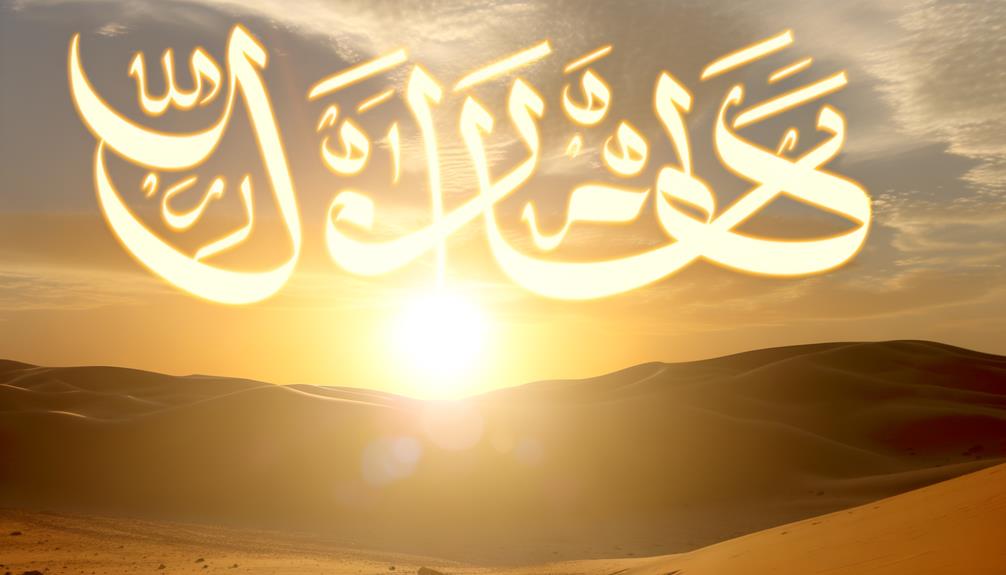
The name Muhammad originates from Arabic, derived from the root 'ḥ-m-d,' which means 'to praise.' The English translation is 'the praised one' or 'worthy of praise.' Historically, it holds significant religious value as the name of Prophet Muhammad, who founded Islam in the 7th century. This name symbolizes profound respect, spiritual devotion, and the Prophet's exemplary virtues.
It enjoys global popularity, transcending cultural and geographical boundaries, and remains a highly revered and widely used name in many regions. To gain further insights into its cultural impact and historical significance, additional information is available.
Key Takeaways
- The name Muhammad in English translates to 'the praised one' or 'worthy of praise'.
- Derived from the Arabic root 'ḥ-m-d,' meaning praise and commendation.
- Historically significant as the name of the Prophet Muhammad, the founder of Islam.
- Symbolizes virtues like integrity, compassion, and leadership.
- Widely popular globally, with numerous spelling variations like Muhammed and Mohamed.
Origin of the Name
The name Muhammad, deeply entrenched in Islamic tradition, originates from the Arabic language and holds significant historical and cultural importance. It is derived from the Arabic root 'ḥ-m-d,' which conveys meanings related to praise and commendation.
Within the context of Islamic history, Muhammad is most prominently known as the name of the Prophet Muhammad, the founder of Islam and its final prophet, according to Islamic belief. This name has been borne by millions across generations, signifying a deep respect and reverence for the prophet.
Its widespread use across Muslim-majority countries and beyond underscores its enduring legacy and the profound influence of Islamic teachings on naming conventions. Muhammad's origin is therefore both linguistically and culturally significant.
Literal Translation
Moving from its origin, the literal translation of the name Muhammad in English is 'the praised one' or 'worthy of praise.' This interpretation stems from the Arabic root word 'ḥ-m-d,' which conveys the meaning of praise, commendation, and admiration.
The name Muhammad, consequently, encompasses a sense of high regard and respect. In linguistic terms, it is a passive participle, signifying the recipient of praise rather than the one who praises. This nuanced translation highlights the profound esteem associated with the name.
The name's significance is further amplified by its widespread use among Muslims globally, symbolizing virtues of honor and respect. Understanding this literal translation provides foundational insight into the name's profound cultural and spiritual resonance.
Historical Background
The name Muhammad has its origins in early Islam, being the name of the Prophet Muhammad, who founded the religion in the 7th century.
Its etymological roots lie in the Arabic word 'ḥammada,' meaning 'to praise' or 'to commend.'
Today, the name holds significant cultural and religious importance across the Muslim world, symbolizing respect and reverence.
Origins in Early Islam
Rooted deeply in the early Islamic period, the name Muhammad holds profound historical significance and reverence. It is famously associated with the Prophet Muhammad, the founder of Islam, who was born in Mecca around 570 CE.
His life and teachings played a pivotal role in shaping the religious, social, and political landscapes of the Arabian Peninsula and beyond. The name Muhammad, meaning 'praised' or 'praiseworthy,' became emblematic of his esteemed position within the Islamic faith.
As the central figure in Islam, the Prophet Muhammad's legacy has guaranteed that his name remains one of the most commonly used and respected names in the Muslim world, symbolizing both spiritual and cultural identity.
Etymological Significance
Etymologically, the name Muhammad derives from the Arabic root 'ḥ-m-d,' which conveys meanings related to praise and commendation. This root forms the basis of several words in Arabic that denote praiseworthiness and gratitude.
Historically, the name Muhammad was chosen with care due to its profound significance, symbolizing an individual who is highly praised and venerated. The name appears prominently in Islamic texts and traditions, reflecting its importance in the cultural and religious fabric of Muslim societies.
Cultural Relevance Today
Understanding the cultural relevance of the name Muhammad today requires examining its historical background and enduring influence on Muslim societies.
The name Muhammad, derived from the Arabic root 'ḥ-m-d,' meaning 'to praise,' holds profound significance due to its association with the Prophet Muhammad, the founder of Islam. This connection has made the name one of the most common and revered in the Muslim world, symbolizing virtues like honesty, compassion, and leadership.
The name's cultural resonance is not limited to historical contexts but continues to shape identities and societal norms in contemporary Muslim communities.
- Historical Significance: Rooted in the life and teachings of the Prophet Muhammad.
- Common Usage: One of the most prevalent names globally.
- Virtuous Symbolism: Represents key Islamic values.
- Cultural Identity: Integral to Muslim identity and heritage.
Religious Significance
The name Muhammad holds profound religious significance due to its association with Prophet Muhammad, who is revered as the final prophet in Islam. His legacy has profoundly shaped Islamic teachings and practices, making the name a symbol of spiritual respect and devotion.
Consequently, the name Muhammad is often chosen to honor his exemplary life and the values he espoused.
Prophet Muhammad's Legacy
Rooted deeply in the hearts of millions, Prophet Muhammad's legacy holds profound religious significance, shaping the spiritual and moral fabric of the Islamic faith.
His teachings, encapsulated in the Quran and Hadith, provide extensive guidance on various aspects of life.
The Prophet's exemplary character, marked by compassion, justice, and wisdom, serves as an eternal model for Muslims worldwide.
His efforts in establishing a community based on the principles of equality and social justice continue to inspire.
- Spiritual Guidance: Core teachings in Quran and Hadith.
- Moral Example: Traits of compassion, justice, and wisdom.
- Community Building: Foundation of an equitable society.
- Enduring Influence: Continued inspiration for Muslims globally.
This legacy underscores the timeless relevance of his life and teachings.
Name's Spiritual Importance
Prophet Muhammad's lasting impact extends to the spiritual significance of his name, revered deeply within Islamic tradition.
The name 'Muhammad,' meaning 'the praised one,' is more than a mere identifier; it embodies virtues such as compassion, integrity, and piety. For Muslims, naming a child Muhammad is a profound act of devotion, symbolizing a desire to imbue the child with the Prophet's esteemed qualities.
Historically, the name has been a source of inspiration, guiding believers in their faith and daily conduct. In Islamic culture, invoking the name Muhammad in prayers and blessings is a common practice, reflecting deep respect and veneration.
Consequently, the name carries a profound spiritual weight, reinforcing the Prophet's timeless legacy in Muslim communities worldwide.
Cultural Impact
Muhammad as a name carries profound cultural significance across various societies and communities globally. It is not merely a personal identifier but a symbol of reverence, tradition, and collective identity. The name Muhammad has been a unifying factor in diverse cultures, influencing various aspects of life including literature, art, and social norms. Its widespread adoption reflects the enduring legacy of the Prophet Muhammad, whose teachings have shaped civilizations for centuries.
- Literary Influence:
The name appears extensively in poetry, prose, and religious texts.
- Artistic Representation:
Artworks often depict scenes related to the Prophet Muhammad's life.
- Social Norms:
The name is commonly chosen to honor religious and familial traditions.
- Global Presence:
Muhammad is one of the most popular names worldwide, spanning different languages and cultures.
Modern Usage
In contemporary society, the name Muhammad continues to be widely embraced, reflecting its enduring relevance and significance across various cultures and communities.
This name, deeply rooted in Islamic tradition, is frequently chosen by Muslim families to honor the Prophet Muhammad, whose teachings and character remain influential.
Additionally, the name transcends religious contexts, occasionally appearing in diverse settings, symbolizing virtues such as integrity, compassion, and leadership.
In various regions, its spelling may differ—Muhammed, Mohamed, or Mehmet—yet the name's essence remains unchanged.
Within modern usage, Muhammad is not only a symbol of faith but also a representation of cultural heritage and identity, seamlessly integrating into the global tapestry of names while retaining its profound historical and spiritual connotations.
Global Popularity
Across numerous continents, the name Muhammad consistently ranks among the most popular and widely used names, reflecting its universal appeal and profound significance. This popularity spans cultural, geographical, and linguistic boundaries, underscoring its deep-rooted historical and religious importance.
In many countries, the name Muhammad frequently appears at the top of baby name charts, symbolizing respect and admiration for the Prophet Muhammad in the Islamic faith.
Cultural Significance: The name holds immense respect in Muslim-majority countries.
Global Reach: It is prevalent not only in the Middle East but also in Europe, Asia, and Africa.
Name Variations: There are numerous spellings and variations, including Mohammad, Mohamed, and Mehmet.
Historical Continuity: Its use has persisted through centuries, maintaining relevance and reverence.
Conclusion
The name Muhammad, steeped in profound historical and religious significance, transcends mere nomenclature to embody an enduring cultural legacy.
Its literal translation, 'praised' or 'praiseworthy,' reflects the reverence accorded to it across various societies.
The name's widespread use, coupled with its historical roots and religious importance, cements its global popularity.
In contemporary times, Muhammad continues to be a beacon of identity and respect, highlighting the intricate tapestry of tradition and modernity.