What Is the Origin and Meaning of Europe's Name
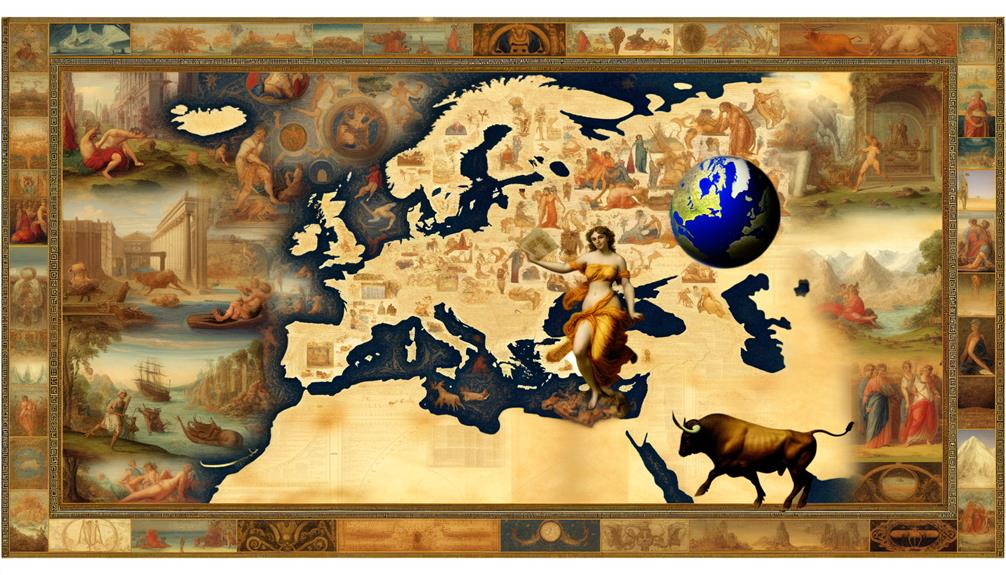
The name 'Europe' originates from ancient Greek mythology, particularly the tale of Europa, a Phoenician princess abducted by Zeus. Etymologically, the term 'Europe' may derive from the Greek words 'eurys' (wide) and 'ops' (face), or the Phoenician word 'Ereb' meaning sunset or west.
Historical records illustrate its adaptation through Greek myths, Roman texts, and Byzantine records. By the Renaissance, the term was redefined through the rediscovery of classical antiquity.
Today, Europe symbolizes cultural unity and complexity, contributing significantly to Western civilization. An exploration of these layers reveals a rich and multifaceted history behind the continent's name.
Key Takeaways
- The name 'Europe' originates from the mythological figure Europa, a Phoenician princess abducted by Zeus.
- The term 'Europe' may derive from the Greek words 'eurys' (wide) and 'ops' (face).
- Another theory suggests the name comes from the Phoenician word 'Ereb,' meaning sunset or west.
- Assyrian interpretations link 'Europe' to the term 'Ereb,' meaning darkness.
- Europe's name has evolved through Greek myths, Phoenician trade, and Roman and Byzantine texts.
Ancient Greek Mythology
Rooted in ancient Greek mythology, the name 'Europe' is believed to derive from the mythological figure Europa, a Phoenician princess abducted by Zeus. This narrative is significant not merely as folklore but as a cultural artifact that provides insight into early Greek perceptions of geography and identity.
Scholars argue that such myths were integral to the Greeks' conceptual framework, influencing their understanding of the world. The abduction of Europa by Zeus, who transformed into a bull, symbolizes the interaction between East and West, reflecting ancient geopolitical dynamics.
Etymology of 'Europe'
The etymology of 'Europe' is deeply intertwined with ancient Greek mythology, which portrays Europa as a Phoenician princess abducted by Zeus.
Scholars also suggest that the term may have Phoenician origins, possibly derived from the word 'ereb', meaning sunset or west.
Over time, interpretations of the name have evolved, reflecting the complex interplay of cultural and linguistic influences throughout history.
Ancient Greek Mythology
Ancient Greek mythology attributes the name 'Europe' to the mythological figure Europa, a Phoenician princess whose abduction by Zeus in the guise of a bull catalyzed her legendary journey across the continent. This mythological narrative highlights the cultural interplay between Greek and Near Eastern civilizations.
Zeus's transformation and subsequent act symbolize divine intervention and the fusion of foreign elements with Greek identity. The etymology of 'Europe' within this context underscores the significance of myth in shaping geographical and cultural understanding.
Europa's story, woven into the fabric of Greek mythology, serves as an allegory for wider historical and cultural interactions, providing insight into how ancient Greeks conceptualized their world and its boundaries.
Phoenician Influence
Intriguingly, the etymology of 'Europe' may trace back to the Phoenician word 'Ereb,' meaning 'sunset' or 'west,' reflecting the region's position relative to Phoenicia. This theory underscores the navigational and trade prowess of the Phoenicians, who were instrumental in early Mediterranean exploration. Evidence supporting this origin includes:
- Geographical Context: 'Ereb' fittingly describes Europe from the perspective of the eastern Mediterranean.
- Linguistic Correlation: Similarities between 'Ereb' and the Greek word 'Erebos,' meaning darkness or west, suggest linguistic borrowing.
- Historical Trade Networks: Phoenician trade routes extended into Europe, facilitating cultural and linguistic exchanges.
This Phoenician influence highlights the interconnectedness of ancient civilizations, shaping the linguistic landscape we recognize today.
Evolving Interpretations
Several theories have emerged over time regarding the etymology of 'Europe,' each offering distinct perspectives based on historical, linguistic, and cultural analyses. One prevalent theory suggests that the name 'Europe' derives from the Greek words 'eurys' (wide) and 'ops' (face), reflecting the continent's broad geographical expanse. Another interpretation links 'Europe' to the Phoenician word 'ereb,' meaning 'sunset' or 'west,' signifying the land to the west of Phoenicia.
| Theory | Key Elements |
|---|---|
| Greek Origin | 'Eurys' (wide) + 'ops' (face) |
| Phoenician Influence | 'Ereb' (sunset/west) |
| Assyrian Perspective | 'Ereb' (darkness) |
Additionally, some scholars argue for an Assyrian connection, where 'ereb' implies 'darkness,' symbolizing the unknown lands in the west. Each theory underscores the complex and evolving interpretations of Europe's name.
Historical Texts and Records
Early historical texts and records provide essential insights into the etymology and evolving significance of the name 'Europe,' reflecting the region's complex cultural and linguistic heritage. Ancient Greek literature, such as Herodotus's 'Histories,' is among the earliest to mention Europe, often describing it in juxtaposition with Asia. Roman texts further delineate Europe, adding layers to its geographical and cultural identity. Additionally, Byzantine records illustrate the term's adaptation over centuries, highlighting the dynamic nature of regional nomenclature.
Herodotus's 'Histories': References to Europe as a distinct entity from Asia.
Roman texts: Expanded geographical and cultural definitions.
Byzantine records: Adaptations reflecting shifts in political and cultural landscapes.
These documents collectively provide a nuanced understanding of Europe's name.
Phoenician Influence
The Phoenicians, renowned for their expansive trade routes across the Mediterranean, played a pivotal role in the cultural and linguistic exchanges that shaped early European civilizations.
Evidence suggests that their interactions facilitated the transmission of various cultural elements, including the etymology of the name 'Europe'.
Phoenician Trade Routes
Phoenician trade routes, which spanned the Mediterranean and beyond, played an important role in disseminating cultural and linguistic elements that may have contributed to the etymology of Europe's name. The Phoenicians, renowned for their seafaring prowess, established extensive networks that facilitated the exchange of goods and ideas.
This dissemination is evidenced by:
- The spread of the Phoenician alphabet, which influenced Greek and Latin scripts.
- The establishment of trade colonies, such as Carthage, which became cultural hubs.
- The transmission of mythological narratives, potentially including the story of Europa.
These routes not only enabled economic prosperity but also fostered cross-cultural interactions that may have embedded Phoenician linguistic elements into the regions they touched, thereby impacting the nomenclature and cultural identity of Europe.
Cultural Exchange Impact
Through their extensive trade networks, Phoenician influence permeated numerous aspects of Mediterranean cultures, from language and writing systems to art and mythology.
The Phoenicians are credited with the widespread dissemination of the alphabet, which became the foundation for Greek and subsequently Latin scripts. This facilitated not only trade but also cultural and intellectual exchange.
Artifacts such as pottery and jewelry reveal a fusion of Phoenician and local styles, indicating a significant artistic impact.
Additionally, Phoenician myths, like those of Astarte and Melqart, were integrated into Greek mythology, becoming Aphrodite and Heracles.
This intermingling underscores the profound role Phoenician culture played in shaping the early European cultural landscape, influencing linguistic development, artistic expression, and mythological narratives.
Roman and Medieval Usage
During the Roman Empire, the term 'Europe' was primarily used to describe the geographical area north of the Mediterranean Sea, delineating it from Asia and Africa. Roman usage of 'Europe' was relatively limited, often appearing in military and administrative contexts. This demarcation was essential for:
- Military Campaigns: Identifying strategic regions for defense and expansion.
- Governance: Organizing provincial territories and managing resources.
- Cultural Identity: Differentiating Roman lands from those of other civilizations.
In the Medieval period, the concept of Europe evolved, influenced by the rise of Christendom. Medieval texts began to imbue 'Europe' with a sense of collective identity, often juxtaposed against the Islamic world. This era saw the term expand beyond mere geography to encompass broader cultural and religious connotations.
Renaissance Interpretations
As the Renaissance unfolded, the term 'Europe' began to take on a more nuanced meaning, reflecting the period's intellectual revival and the re-examination of classical antiquity. Scholars of the Renaissance era revisited ancient texts, leading to a cultural reawakening that redefined Europe's identity. The rediscovery of Greco-Roman literature and philosophy underscored a sense of shared heritage and intellectual lineage.
| Aspect | Renaissance Interpretation |
|---|---|
| Intellectual Revival | Emphasis on classical antiquity |
| Cultural Identity | Rediscovery of Greco-Roman heritage |
| Geographic Scope | Expanded understanding of boundaries |
| Political Ideals | Influence of classical governance |
| Artistic Expression | Renaissance art reflecting antiquity |
This period marked a pivotal moment in shaping Europe's modern conceptualization, intertwining historical insights with contemporary advancements.
Modern Understanding
In contemporary discourse, the name 'Europe' is understood not just as a geographical designation but also as a complex cultural and political identity shaped by historical evolution and modern integration efforts. This understanding encompasses a range of dimensions:
- Cultural Heritage: Europe is often seen as the birthplace of Western civilization, with rich contributions in art, philosophy, and science.
- Political Integration: The European Union symbolizes a significant attempt at uniting diverse nations under common economic and political frameworks.
- Global Influence: Europe's historical colonial activities and its ongoing role in international organizations underscore its impact on global affairs.
These factors collectively contribute to a nuanced and multifaceted understanding of what 'Europe' represents in the modern era.
Conclusion
The name 'Europe' unfurls like an ancient tapestry, woven from threads of Greek mythology, Phoenician influence, and Roman chronicles, each contributing to its rich semantic mosaic. Historical texts and etymological analysis reveal an intricate dance of language and culture.
From medieval manuscripts to Renaissance reinterpretations, the evolution of the term mirrors the continent's complex history. In the modern era, 'Europe' stands as a palimpsest, bearing the indelible marks of its storied past while continuing to evolve.