Leela Name Meaning in English
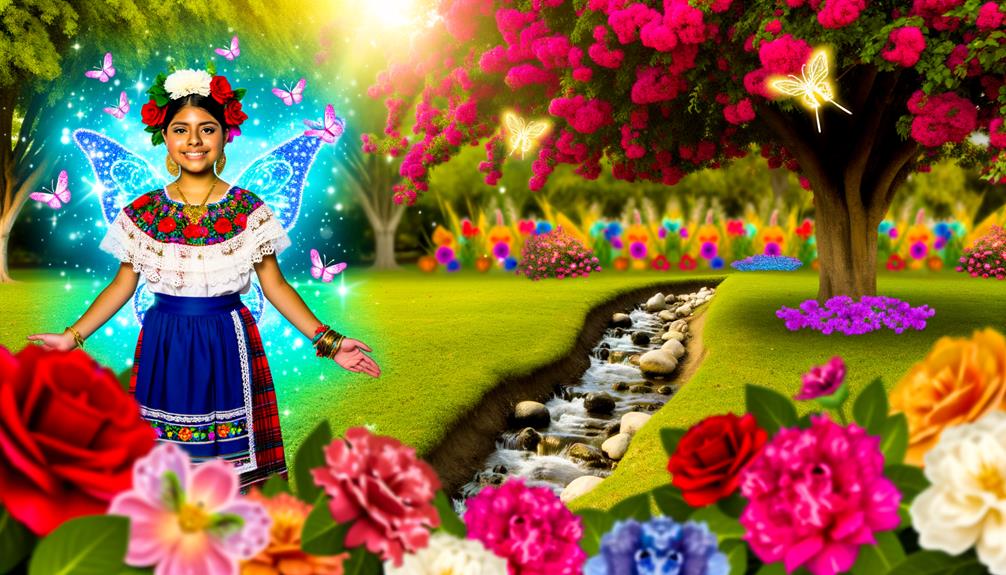
The name 'Leela,' derived from the Sanskrit term 'Lila,' intricately means 'divine play' or 'cosmic drama.' It originates from the root 'li,' meaning 'to play,' and the suffix '-la,' denoting a dynamic process. Deeply embedded in Hindu mythology, it epitomizes the effortless, joyous activities of deities like Krishna and Shiva.
This concept underscores the non-dualistic perspective where the divine and mundane intermingle, highlighting the sacred spontaneity of life. The name 'Leela' continues to resonate in both traditional and contemporary contexts, embodying creativity and spiritual essence.
To uncover more about this fascinating term, explore its deeper cultural and spiritual implications.
Key Takeaways
- 'Leela' means 'divine play' or 'cosmic drama' in Sanskrit.
- It signifies the joyous and effortless activities of deities like Krishna.
- The name reflects the interplay between the divine and mundane aspects of life.
- 'Leela' embodies the concept of life as a sacred performance filled with divine purpose.
- Modern usage of 'Leela' highlights its cultural resonance and spiritual depth.
Etymology of 'Leela'
The term 'Leela,' derived from Sanskrit, signifies 'divine play' or 'cosmic drama,' reflecting its profound religious and philosophical connotations.
This etymological root traces back to ancient Hindu texts where 'Leela' encapsulates the spontaneous, joyous activities of deities like Krishna and Shiva. The word itself stems from the Sanskrit root 'li,' meaning 'to play,' combined with the suffix '-la,' denoting an ongoing, dynamic process.
This combination underscores the continuous and effortless nature of divine actions, aligning with Hindu cosmology's portrayal of the universe as a manifestation of divine will. The term's linguistic construction highlights the interplay between action and intent, emphasizing the non-dualistic view of reality where the divine and mundane are intrinsically intertwined.
Cultural Significance
Reflecting its etymological roots, 'Leela' holds substantial cultural significance in various aspects of Hindu tradition and spirituality. Derived from the Sanskrit term 'लीला' (Līlā), the word embodies a multifaceted concept that permeates religious narratives and cultural expressions.
- Mythological Narratives: 'Leela' is often used to describe the divine play of deities, especially Krishna, whose actions are seen as expressions of cosmic drama.
- Literature and Art: The concept influences classical literature, dance, and visual arts, providing a thematic framework for storytelling and performance.
- Cultural Practices: Festivals and rituals frequently incorporate elements of 'Leela', emphasizing the joyful and playful aspects of divinity.
This term encapsulates a rich tapestry of cultural elements that highlight the interplay between the divine and the mundane.
Spiritual Interpretations
In spiritual discourse, 'Leela' is interpreted as the divine play through which the universe is manifested and sustained by the actions of the divine. Deriving from the Sanskrit root 'लीला' (Līlā), it signifies the cosmic drama orchestrated by the Supreme Being.
This concept is pivotal in various Hindu traditions, encapsulating the interplay between the material and spiritual domain. 'Leela' underscores the spontaneity and creative freedom of the divine will, suggesting that all creation is an expression of the divine's playful energy.
This term invites a deeper understanding of existence as a sacred, dynamic process, where every element is interwoven with divine intention. Thus, 'Leela' portrays life itself as a sacred performance, filled with purpose and divinity.
'Leela' in Literature
Numerous literary works have explored 'Leela' as a central theme, delving into its etymological roots and its profound implications within the narrative structure. Derived from the Sanskrit word 'लीला' (Līlā), meaning 'play' or 'divine play,' 'Leela' embodies the intricate interplay between fate and free will, often reflecting deeper metaphysical and philosophical inquiries. In literature, 'Leela' serves as a vehicle for exploring multifaceted dimensions of human experience and cosmic order.
- Mythological Texts: Prominent in Hindu epics like the Mahabharata, where 'Leela' illustrates divine interventions and moral dilemmas.
- Modern Novels: Used to depict the spontaneous and unpredictable nature of life.
- Poetry: Explored as a motif to convey existential themes and divine mysteries.
This thematic resonance underscores 'Leela's' enduring literary significance.
Modern Usage and Popularity
The contemporary usage of the name 'Leela' has seen a resurgence, marked by its adoption across various cultures and contexts while retaining its intrinsic connotations of playfulness and divine essence.
This revival can be attributed to its phonetic appeal and its rich etymological roots, derived from the Sanskrit word 'Līlā,' meaning 'divine play.' Modern parents appreciate its simplicity and cultural resonance, making it a popular choice in both Western and Eastern contexts.
The name's versatility is further exemplified by its presence in media and literature, where it embodies notions of creativity and spirituality. This cross-cultural embrace underscores the enduring relevance and universal appeal of 'Leela,' highlighting its significant role in contemporary nomenclature trends.
Conclusion
The term 'Leela' embodies profound etymological roots and cultural significance, reflecting a tapestry of spiritual interpretations and literary applications.
A nuanced understanding reveals its enduring resonance across time, transcending mere nomenclature to symbolize cosmic play and divine action.
Contemporary usage underscores its sustained popularity, suggesting a perennial appeal.
As such, 'Leela' serves as a linguistic and cultural artifact, echoing through the corridors of history and into the modern lexicon, encapsulating a rich and multifaceted heritage.