Raven Name Meaning and Origin
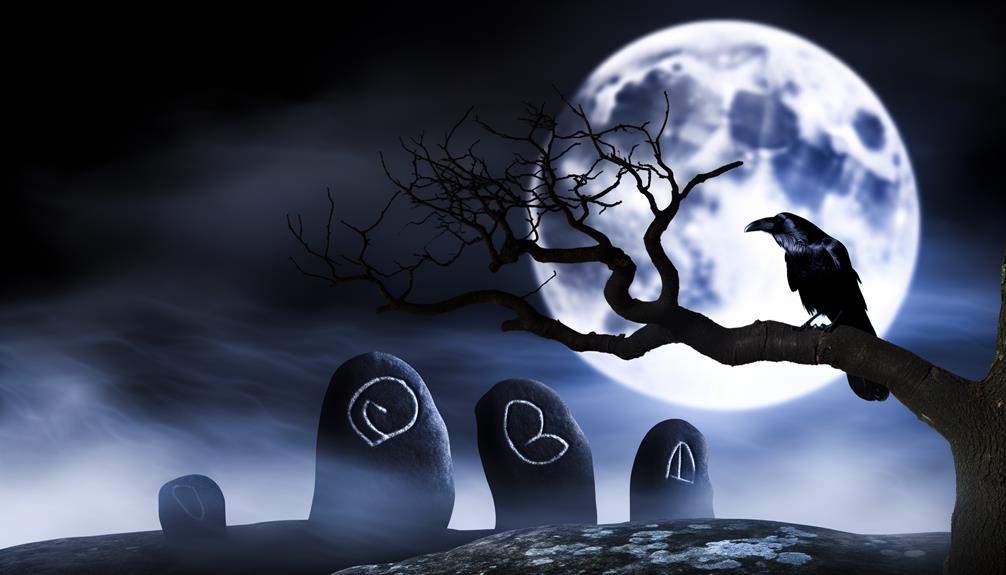
The name 'Raven' originates from the Old English word 'hræfn,' symbolizing the intelligent black-plumaged bird. Its roots run deep in Norse mythology, closely associated with the god Odin, representing thought and memory.
Across cultures, ravens are viewed as omens, messengers, and symbols of wisdom, foresight, and transformation. The name experienced a resurgence in the 1970s, influenced by countercultural movements, and saw peak popularity in the 1990s.
Modern usage reflects ongoing fascination with nature-inspired, mystical names. To explore the intricate symbolism and historical influences behind the name 'Raven,' there is much more to uncover.
Key Takeaways
- The name 'Raven' originates from the Old English word 'hræfn,' meaning the intelligent black-plumaged bird.
- In Norse mythology, ravens symbolize thought and memory, associated with the god Odin.
- Ravens are symbols of wisdom, foresight, and prophetic abilities in various mythologies.
- The name 'Raven' gained popularity in the 1990s, influenced by media and unique naming trends.
- Modern usage of 'Raven' evokes themes of mystery, intellect, and transformation in literature and pop culture.
Historical Origins
The name 'Raven' finds its roots in Old English and Norse mythology, where it was often associated with the birds revered for their intelligence and prophetic abilities.
In Norse mythology, ravens were emblematic of the god Odin, who had two ravens, Huginn and Muninn, symbolizing thought and memory. These birds were believed to traverse the world, gathering information and relaying it back to Odin.
Similarly, in Old English lore, ravens were seen as omens and messengers, often appearing in poetic and literary texts to signify foresight and wisdom. This cultural reverence for the raven underscored its symbolic significance, making the name 'Raven' imbued with connotations of insight, mystery, and a profound connection to ancient traditions and beliefs.
Etymology
The etymology of the name 'Raven' originates from the Old English word 'hræfn,' which directly translates to the bird known for its black plumage and intelligence.
This term has deep-rooted significance in various mythologies, symbolizing both wisdom and mystery.
Over time, the meaning has evolved, reflecting cultural shifts and the enduring allure of the raven in folklore and literature.
Old English Roots
Rooted deeply in Old English, the name Raven originates from the word 'hræfn,' which refers to the bird known for its intelligence and black plumage. This term has been traced back to the early medieval period, reflecting the significant role ravens played in the cultural and linguistic landscape of the time.
The Old English language, a Germanic tongue spoken in England from approximately the 5th to the 11th century, provides a rich etymological backdrop for the name. The Raven's presence in Old English literature and folklore underscores its symbolic importance, revealing a connection between language and the natural world.
The word 'hræfn' exemplifies the descriptive and nature-oriented vocabulary characteristic of the Old English lexicon.
Symbolism in Mythology
As the name Raven evolved from its Old English roots, its symbolic resonance extended into various mythologies, where the bird often epitomized wisdom, transformation, and prophecy.
This multifaceted symbolism is evident in numerous cultural narratives:
- Norse Mythology: The ravens Huginn and Muninn, representing thought and memory, served as the eyes and ears of Odin, the Allfather.
- Celtic Mythology: Associated with the Morrigan, the raven was seen as an omen of war and transformation, heralding both destruction and rebirth.
- Native American Mythology: The raven was revered as a trickster and a creator, symbolizing the power of change and the mysteries of nature.
These mythological associations imbue the name Raven with profound depth and historical significance.
Evolution of Meaning
Etymologically, the name Raven traces its origins to the Old English word 'hræfn,' which itself is derived from the Proto-Germanic 'khrabanas,' reflecting a lineage steeped in linguistic history and cultural significance.
This etymological pathway underscores the bird's prominence in ancient cultures, where ravens were often revered. The Proto-Germanic 'khrabanas' connects further back to the Proto-Indo-European root '*k̥orh₂-', meaning 'to croak,' emphasizing the bird's distinct vocalization.
Throughout history, the raven has been a symbol in various mythologies, from Norse to Native American, imbuing the name with rich, multifaceted meanings. Its evolution from a simple descriptor of a bird to a name embodying mystery and intelligence illustrates the dynamic nature of language and cultural interpretation.
Mythological Significance
The raven holds a prominent place in mythologies across various cultures, symbolizing a wide array of meanings from wisdom to death.
In Norse mythology, Odin's ravens, Huginn and Muninn, were revered as messengers providing critical intelligence.
Similarly, Native American legends often depict the raven as a cunning trickster and creator, highlighting its multifaceted significance.
Symbolism in Various Cultures
Rooted deeply in the mythologies of various cultures, ravens are often depicted as creatures of profound symbolism, embodying themes of wisdom, transformation, and mystery. These birds hold significant roles across different civilizations, cementing their place in cultural narratives.
- Norse Mythology: The raven is closely associated with Odin, the Allfather, who is accompanied by two ravens, Huginn and Muninn, symbolizing thought and memory.
- Celtic Traditions: Ravens represent prophecy and insight, often linked to the Morrigan, a goddess of war and fate.
- Native American Beliefs: Various tribes view the raven as a creator and trickster figure, a harbinger of change and transformation.
Understanding these mythological roles provides a window into the rich, complex symbolism attributed to ravens across human history.
Legends and Folklore
Across numerous legends and folklore, ravens are frequently portrayed as omens, messengers, and pivotal figures in mythological narratives.
In Norse mythology, Odin's ravens, Huginn (thought) and Muninn (memory), traverse the world to bring information to the god.
Native American traditions often view the raven as a creator and trickster, embodying both wisdom and cunning.
In Celtic lore, the raven is linked to the warrior goddess Morrigan, symbolizing war and fate.
Greek mythology associates ravens with Apollo, where they are seen as symbols of prophecy and protection.
These diverse mythological roles underscore the raven's complex representation across cultures, highlighting its significance as a multifaceted archetype with deep historical roots.
Cultural Symbolism
In various cultures, the raven has been revered as a symbol of transformation and intelligence, often associated with myths and legends that underscore its significance in human history. This enigmatic bird has captivated human imagination across different epochs and societies, featuring prominently in symbolic narratives.
- Norse Mythology: Ravens Huginn and Muninn were thought to fly across the world, gathering knowledge for the god Odin, symbolizing wisdom and memory.
- Native American Traditions: Many tribes view the raven as a trickster and transformer, playing pivotal roles in creation myths and embodying the duality of good and evil.
- Celtic Lore: The raven was linked to the battlefield and war gods, representing both prophecy and the cyclical nature of life and death.
These examples highlight the raven's profound cultural resonance.
Modern Usage
The raven's symbolic significance has smoothly shifted into modern contexts, where it continues to evoke themes of mystery, intellect, and transformation in various domains such as literature, pop culture, and art. The bird's dark plumage, keen intelligence, and enigmatic presence have made it a versatile symbol. In literature, Edgar Allan Poe's "The Raven" remains a quintessential example, while in pop culture, ravens appear in shows like "Game of Thrones." Artists also embrace the raven, utilizing it to convey complex themes.
| Domain | Example |
|---|---|
| Literature | Edgar Allan Poe's "The Raven" |
| Pop Culture | "Game of Thrones" |
| Art | Surrealist paintings featuring ravens |
| Film | Alfred Hitchcock's "The Birds" |
| Music | Songs by artists like Leonard Cohen and The Alan Parsons Project |
This ongoing relevance underscores the raven's enduring resonance.
Name Popularity
Beyond its symbolic presence, the name 'Raven' has seen varying degrees of popularity, reflecting cultural trends and historical influences. Historically, the name gained traction in the 1970s, influenced by countercultural movements and a growing fascination with nature and mysticism.
Its popularity peaked in the 1990s, partly due to media representations and an increased interest in unique names. More recently, 'Raven' has experienced a resurgence, driven by the modern trend of nature-inspired names.
Key periods of popularity for the name 'Raven' include:
- 1970s: Emergence during countercultural movements.
- 1990s: Peak popularity influenced by media.
- 2010s to present: Resurgence due to contemporary naming trends.
This fluctuating popularity underscores the name's enduring appeal.
Conclusion
The name 'Raven' carries profound historical, etymological, mythological, and cultural significance. Its roots can be traced to ancient civilizations where the raven was often revered.
Despite concerns about its perceived darkness, the name's rich associations with wisdom and transformation persist in modern usage.
The continued popularity of 'Raven' demonstrates its enduring appeal, reflecting a deep-seated human fascination with the bird's complex symbolism.
Ergo, 'Raven' remains a name imbued with multifaceted meaning and historical depth.